Tuesday, July 18, 2006

World War III?: Link Roundup

It's irresponsible to be a liberal blogger, like myself, and not pause to reflect on Israel's War, which is hopefully not our war. Before I do, let me give you some links to my "go to" blogs on the Middle East with some sample excerpts to whet your appetite:

(1) Unclaimed Territory(Glenn Greenwald): Openly Debating U.S. Involvement in Israel's War and Is Israel's War Also "Our War"?


We have 140,000 soldiers sitting in the center of the Middle East, and we have had multiple skirmishes in the past with both the Syrians and Iranians as a result of our activities in Iraq. In a climate where the administration's most prominent and loyal followers are urging that we wage war on those two countries, and with the administration itself at least sounding as though they are tempted by the idea, the likelihood of unintentional escalation, or reckless expansion of our war, is extremely high. If that is really a risk which our country wants to take after a full and open debate on the topic, so be it.

But the last thing that ought to happen is a repeat of our invasion of Iraq, where we began an extremely risky and misguided war against a country that wasn't threatening us without meaningful media scrutiny and therefore without a meaningful debate. The debate was not meaningful because objections to the war were stigmatized as seditious or even anti-semitic. That is a mistake that the U.S. cannot afford to make again.

The fact that the administration does not intend to wage war on Iran and/or Syria doesn't mean that such a war won't occur. And if the administration has not committed itself yet to causing such a war, they sure don't appear to be shying away from it either. They surely know full well that they are playing with gasoline near a raging fire, and they appear to be indifferent to the risks, if not actively seeking them. Why that is the case, and whether it is wise, must be topics that are fully open to examination.


(2) Once Upon a Time (Arthur Silber): The Impossibility of Discussing Anything At All and The Danger Spreads and It's Much Later Than We Think: Why It Is Not Our War

JUST TO ADD: I didn't state this earlier, primarily because I consider it so painfully obvious. There is an alternative to this increasingly out of control spiral of events. If the Bush administration wanted to, they could bring all the pressure at their disposal to bear on the various parties involved -- which pressure is fairly monumental, it should be noted -- and arrange for an immediate cease fire, to be quickly followed by intensive negotiations. The negotiations might not work in the end, but at least a period of reprieve would give everyone a chance to catch their breaths, and reconsider where this path is leading.

Of course, that assumes that peace, and not war, is the administration's objective. Since we invade and occupy countries that never threatened us, and because this administration has all but interred diplomacy for good, the evidence is now close to absolutely conclusive that this is not, in fact, the administration's aim.


(3) Hullabaloo(Digby): In Plain Sight


I think we all know his name is Dick Cheney, original signatory of the PNAC and the man who stated baldly that he came into office with ideas about executive power and America's place as a sole superpower that he's been percolating since the late 70's. Cheney has been playing a long game, much longer than anyone else in the administration. Like a shark, he is single minded, focused and relentless. By his standards, and the standards of his multi-national corporate and neocon theorist patrons, he has been tremendously successful so far. They do not see the dangers staring them in the face, or if they do they truly believe the risk (and the blood and money) are worth it. They have no doubts.

It's tempting to write them off as a bunch of kooks, but it is their kooky vision that is right now playing out in the mid-east. It's not that they are necessarily directing it, to be sure. But they are always prepared to take advantage of circumstances that advance it. And like all historical leaders of aMarch of Folly they believe, despite all evidence to the contrary, that everything will turn out ok in the end.

(4) The (liberal) Girl Next Door: World War III: Good for the GOP, Bad For Everyone Else

I have little doubt that this situation will escalate further and will eventually draw in Iran and Syria. Perhaps the Bush administration is hoping that Israel will strike Iran’s nuclear facilities, but it might also be the perfect opportunity for the Bush administration to do it themselves. They’ve wanted to cripple Iran for a long time, why would they pass up the chance to do it now? Of course it would be a stupid move and disastrous for America if we did allow the violence to escalate into World War III, but as Newt Gingrich pointed out this weekend, it would be great for the Republicans in the mid-term elections. Gotta love those Republicans, always looking on the bright side, or rather looking out for the bright spot for themselves.

And just imagine all the new war money that will pour into the bank accounts of the contractors that have probably stolen as much as they can while using Iraq as a shield, time for a new war. World War III will give them new cover, new no-bid contracts for new munitions, new fighter jets and maybe even some new nuclear warheads. But the cherry on top will be a new lease on life for the Republicans who will be able to use fear once again to keep their hold on power. Never mind that it was their ridiculous neo-con fantasies that brought us to this point, they will still be able to sell their “tough on terrorism” crap to the American public if they convince us that this is the big one. All they have to say is, “Do you really want wimpy liberals who aid and abet the enemy in charge during a war that could likely threaten the homeland?” Hey, it worked like a charm when we were only talking about rogue terrorists, it will work even better if we’re talking about a World War and nuclear warheads pointed at our cities.

(5) firedoglake: Every Bomb Makes Hezbollah Stronger(Steve Gillard)

The problem is that war cannot solve the problem Israel has with Hezbollah. They cannot fight a two or three front war. They need a buffer zone and no more attacks and that will only come from negotiations.

I think that’s dawning on the IDF commanders, that their force has limits, they’ve made their points, and every dead child seen on TV enhances their enemies. It may not be reflected in New York, but the EU looks aghast at this, and it doesn’t help Israel’s long term security

In fact, one might think Hezbollah wanted this attack, knowing the Israelis would react in such a disproportionate manner. One trick in warfare is to get your enemy to act in a predictable way, They knew an ambush and kidnapping would work to do just that.

While a lot of people are reflexively pro-Israel, they don’t get that Israel is being demographically engulfed by Arabs. If they want Israel to last, there has to be peace, meaningful, real peace. There will come a day when the Arabs can resist the IDF and after that, Israel will have no leverage.


(6) Michael Lerner (at Alternet): Middle East Violence: NeoCon's Fantasy


In my books Healing Israel/Palestine (North Atlantic Books, 2003) and The Geneva Accord and Other Strategies for Middle East Peace (North Atlantic Books, 2004) I show that both sides have a legitimate narrative that needs to be heard and recognized by the other side; that neither side will ever prevail through violence, and that each side needs to acknowledge that it has been unreasonably cruel and insensitive to the needs of the other.

Yes, of course it's clear that in the last forty years Israel's had the upper hand and has used its power in an immoral way. But these are peoples with long historical memories, and Israeli partisans are as unlikely to convince Israelis whose families escaped oppression in Arab lands that there was no Arab oppression of Jews as Palestinian partisans are to convince the Palestinians that they never really lived in the homes in Palestine from which they were expelled by the wars from 1947-1967.

Nor are we likely to get to peace by trying to discount the fears of Israelis and Jews who face a stream of violence -- from terrorist attacks to Hamas-launched Qassam rockets to physical assaults on random Jewish people from Paris to Moscow -- than we are to convince Palestinians that Israel is merely being sensibly defensive and exercising its right to protect itself. These kinds of triumphalist narratives must be abandoned.

But they won't be as long as Bush and his advisors in the neo-con camp see in the current violence yet another opportunity to reframe the Middle East struggle as one that will provide ex post facto justification for the war in Iraq and enticement for new militarist adventures to destabilize or overthrow oppressive regimes in Iran and Syria.

Monday, July 17, 2006

Women Cry More Easily, Really?

Lindsay got me thinking about this question today, via her post on Ben Barres (the transgendered Neurobiologist who recently wrote an article on gender discrimination in Nature.) Barres described himself as crying less easily since the operation. The implication is that women (or folks with less testosterone) cry more easily. Lindsay noted that she saw many of her male friends weep after the World Cup. Shit, I was sort of moved by the players' tears after both the Germany-Italy game and the France-Italy one.

I started thinking about whether or not I cry easily. And, well, the answer is yes and no. I find crying nearly impossible to do in my actual life. I have often tried to manufacture tears because I was so embarrassed by what I took to be an apathy or numbness at horrific situations. I attended the funeral of a student of mine, who was brutally murdered, and I couldn't cry. I wanted to; I wanted to after the fact and couldn't. I remember telling a colleague about her murder, and my colleague teared up immediately, which left me in awe . . . I also remember asking a male colleague of mine to read a letter I wrote to an ex after he broke up with me. My male colleague teared up when he read it, and yet, alas I sat their tearless. Now, don't get me wrong. I have cried, particularly when I feel really frustrated or if I feel like someone is abandoning me. But, even in those situations, I rarely cry. I have to be very frustrated and worn down. Just today I had to face the real possibility that my doggie has some kind of serious problem, such as colon cancer, and I couldn't cry. I started wondering if I would cry were the Vet to tell me that my dog was dying.

On the other hand, I cry at almost any sappy (stupid even) melodrama TV show, movie or commerical. Whoever did the research on what music to play or what camera lens and angle to use (or whatever) to make the spectator cry, well, he/she got my number. I am sort of embarrased by how easily I cry in these venues. The only other person I know like this is my mother. Her theory is that this is safe outlet for tears. Perhaps?

But enough about me . . .what are your impressions about gender and tears?

Sick Pooch

Posting has been rather sparse and brief the last few days. My dog is quite ill and I have to take him to the Vet today. I am not sure how bad it is, but he is 7 and has had seizures his whole life. The whole thing is getting me down. So, all of you who are kind enough to read this blog, please keep good thoughts of Marty today as I take him to the Vet. I am hoping he just ate something awful . . .

Sunday, July 16, 2006

Friday, July 14, 2006

The Simone De Beauvoir Bridge

How cool is that?

Unfortunately, this bit of reporting undercuts the greatness of this event:

De Beauvoir - the lifelong companion of existentialist philosopher Jean Paul-Sartre - made a name for herself with the 1949 book The Second Sex.

So Sartre was the philosopher and she was the companion? Lame! Btw, the book that brought her acclaim was The Mandarins (she got the Prix Goncourt). She still has not been admitted into the L'Academie Francaise!

Hat Tip: Becky.

A "Fresh" Approach to an Old Problem

Via Pandagon and Majikthise, I discovered this newstory about Ben Barres, a Neurobiologist who had a sex change (from Barbara to Ben) nine years ago. I haven't a subscription to Nature, hence I cannot get my hands on the original piece. However, the WaPo has a write up of Barres' Nature piece here.

A "fresh" (can you hear the sarcasm) perspective on the question, why aren't there as many women in top research positions in science. Here are some choice quotations from the WaPo piece:

"By far," Barres wrote, "the main difference I have noticed is that people who don't know I am transgendered treat me with much more respect" than when he was a woman. "I can even complete a whole sentence without being interrupted by a man."

Barres said the switch had given him access to conversations that would have excluded him previously: "I had a conversation with a male surgeon and he told me he had never met a woman surgeon who was as good as a man."

What a shock? There is actually bias against women in the workplace? You jest? But, why listen to me, afterall, I am a woman. So, if you don't believe what a chick says, check out Ben Barres on the matter.

And, read what Amanda has to say on the matter.

Friday Funny

Via Bitch Ph.D., I bring you this lovely video clip of Jesus Christ, The Musical.

I Need Your Help, Dear Readers . . . .


This feminista is feeling a bit downtrodden today because she can't seem to get into any rhythm with her writing. I have been stuck on my third chapter of the manuscript for quite awhile. I know what I want to say--that's not the problem. I just find the writing extremely slow going and I get distracted in the details (hunting down a citation, rereading a passage from secondary literature, or rereading what I have written thus far to edit). I give up!

What advice do y'all have to help me get over my slow writing phase? I can whip these blog posts out lickety split. But, the manuscript is proceeding at a glacial pace (and not the sort of glacial pace the Al Gore is freakin' us out with in An Inconvenient Truth).

So, if you please, share with this feminista (and all her readers) your tricks for getting more effective writing done at a faster clip.

Thursday, July 13, 2006

What Up Slut?

A few days ago a post--wherein I referred to another blog--turned into a discussion of whether or not it is anti-feminist to use the phrase "bitch-slap." Now, I am not sure we settled this discussion, although Hanno made some compelling points about its origins and then asked why using "bitch slap" is any less horrific than using the word "rape," albeit metaphorically. For my part, political correctness always seems rather stifling. Now, I best back up and explain what I mean by that. I don't think we should feel free to use hurtful phrases willy nilly to stereotype and malign groups of people or individuals. I do refrain, perhaps due to my good liberal credentials, from using phrases or descriptors that people will find offensive. It's just plain good manners. If calling someone "black" for example, offends them, then why do it? I have noticed, however, that I refrain from using certain phrases only when I know, explicitly, that they are hurtful to another. Otherwise, I am pretty loose with the kind of slang I am willing to use, even if the words have a really horrible connotation or historical past.

Hanno asks:

"Isnt this a reference to spousal abuse in the first instance, and jail house rape in the second instance? Isn't the 'bitch', as used in this case, a woman more or less owned by someone, or a man who is forced to act like such a woman? Am I wrong, or isnt this prison slang?"


I honestly don't know what the origins are of this phrase, but I am certain that Hanno's account is correct. For me, the question is: does anyone who utters this phrase--"bitch slap,"--particularly if it is feminista like me, using it to characterize a philosophical argument against a wingnut--automatically invoke the past meanings? When I use this phrase, am I necessarily contributing toward a culture of violence against women (and men)? If that is true, wouldn't it equally apply to phrases like "mother fucker," "bitch," "bastard," etc. It's hard to find slang phrases that don't have some violent/sexual connotation. One could choose to refrain from using slurs and slang altogether, and I think that is a legitimate choice. Many of my closest friends never swear or utter such urban slang, precisely because the images that these phrases conjure up for them are horrific. I am, however, clearly unfazed by these same images. Why? In part because I simply don't think of these exact images when I use the words--the usage has changed, the connotation has changed and therefore, I utter them--unfortunately--as easily as any other slang.

This brings me to my point: words/phrases seem to carry different connotations given which linguistic community you are in. If I use the phrase "bitch slap," as a way of describing what I think my brother should do to his fiance when she gets out of line [I WOULD NEVER DO THAT PAM!], then Hanno's point is right on. But, if I use the phrase to describe what Jon Stewart did to Tucker Carlson, does it really put in mind brutal violence against women? It might, however, if I say that X blogger "bitch slapped" Ann Coulter. In this instance, I am sort of reveling in the violence against women connotation, aren't I? Now consider what happens if a misogynist uses the phrase to describe how he handled a female co-worker or girlfriend? Or, what if a gay male fashion designer used it to describe how a model treated him? The fact is that the context of usage and the linguistic community you are in changes, dramatically, what the phrase means and how it comes across.

This leads me to my last observation: how young girls use the phrase "slut." The NYT published a piece--in the Style section--dedicated to decoding what is going on with young girls calling each other 'slut.' The idea here is that older women can use this word--ironically even--and take it in stride. If a self-possessed femininsta, like myself, calls my best friend 'I' a slut--it generally is a term of endearment. We are saying much more with the word than: "you loose, sexually depraved woman." We both know the horrible ways in which this word is used to control female sexuality, and we both reject that move. So, we use it ironically--that is, we obviously don't think that the other is a 'slut,' and use it to deflate the sting it's suppose to give when uttered by some misogynist fuckwad. This sort of irony doesn't always seem to be at play among teenagers, however:

Still, “slut’’ stings much more for girls than for women. Teenage girls get the cultural message that they should look provocative. Their social circles are small, so everyone knows who is doing what with whom. And those who do acquire the slut label have to face up to it daily in school and endure snickers about the very thing girls at that age are most embarrassed about — their sexuality.

“All of our pop icons look like porn stars,” Ms. Rubenstein said. “However they’re all virgins, quote unquote,” she said, referring to Jessica Simpson and Britney Spears. “That’s a very complex message to send to girls.”

For junior high and high school girls, said Leora Tanenbaum, the author of “Slut! Growing Up Female with a Bad Reputation,” being labeled a slut is still painful and humiliating, despite pop culture’s semi-embrace of the term. Ms. Roxas of Gurl.com said teenagers often inquire about it.

Tanenbaum goes on to emphasize that the double standard--young girls are suppose to tart it up like Britney, but stay chaste--complicates how teenage girls handle the slur. Sure, the social context has a huge part to play in how people experience slurs. But what is equally important is the intention of the one hurling the slur (nice phrase!). If Sandy Dee calls Britney a slut, largely because Britney is more popular and thereby gets more male attention, then most likely her motivation is to sting/humiliate Britney. But, if Sandy Dee and Britney are good friends--partners in crime--then calling each other 'slut,' might be a term of endearment. I doubt, however, that it is said ironically. It's slang among young girls, and slang emanating from the Devil-Wears-Prada fashionista world. So, the origins is this case is most likely sassy gay men.

Alas, it seems to me that phrases take on all sorts of connotations depending on the context of its use and so it seems perfectly kosher to use phrases like "slut" and "bitch slap" without sullying your feminsta credentials. I guess, I just don't like the idea of political correctness, at least in the sense of shaking our fingers at other fellow liberals for using "bad words." The words are only bad if the person intends for them to sting. If a young man says something stupid like--"man, I wish I could get raped," he is not an ass for having used the word rape wrongly. He is an ass for being too stupid to understand that no one would want to be raped and that rape is not equivalent to sex initiated by a woman. So, I think that we need to be on guard for the kind of moralism that often creeps in when evaluating the writings of feministas and such.

Wednesday, July 12, 2006

When Are White Lies Ethical?

A former student emailed me today to run an idea by me that she is considering writing her Master's Thesis on. In a nutshell, she wants to refute Kant's argument that any lie is a violation of the Categorical Imperative. Now, Kant makes this argument for epistemological reasons. A lie, for Kant, is an affront to the law of non-contradiction and if we willed any maxim that said "white lies are good in cases where we want to protect the feelings of our loved ones" to be a universal law, then, Kant argues, we would unravel the very conditions of intelligibilty that we rely upon to make any sense.

To challenge Kant's argument against laws, however, need not involve an epistemological argument, does it? Is it really the case that a little fib here and there corrupts all possibility of intelligibility? Certainly not. When I visit my great aunt, and she serves a freezer burned pie and a slightly charred roast, am I threatening the ground of sense-making if I say: "Yes, Auntie, I absolutely loved the roast and pumpkin pie."

These are the sort of white lies that appear to be quite ethical acts. However, one cannot rely upon Kantian ethics to justify why these are ethical lies. (I like that--"ethical lies"--would be a good title). Anyway, one is far more likely to find justification for white lies in the body of work now called Care Ethics. Nel Noddings refuted Kant's duty based approach to ethics, not by claiming that we should do things out of love rather than duty--this would be just a mindless critique. Rather, she argued for "ethical caring." Some of the caring we do for others is "natural," in that it is instinctual or unconscious; we do it perhaps because we are biological beings who instinctually care for our offspring. One cannot use such acts as the model of ethical (virtuous behavior), argues Noddings, for much the same reasons that Kant argues we cannot consider acts done out of inclination to be dutiful. An act is ethical if and only if we do it because it is right, not because we want to or it is easy to do. Kant famously uses the example of the suicidal, miserable young man who, despite his deep inclination to off himself, chooses to live. This is duty. (Oy Vey--if only they had Prozac in the 18th Century!)

Ethical Caring--Noddings rethinking of duty--involves responding to concrete situations, wherein another needs our care, even when we do not feel disposed to care for the other. Why should we care for others?, asks Noddings. Because we value as a people the relatedness of care. If we do not habituate a caring character--that is, we must continually engage in actions that concretely express care for others, particularly when they are vulnerable. By repeatedly doing caring things, we become a caring person, and we demonstrate to others that caring is a valuable and necessary act.

Of course, one must still work out all the details about what is means to care for someone. For example, my graduate professor loved the example from Fried Green Tomatoes wherein Idgie gives the drunk, Smokey Lonesome, a stiff drink to stave off the D.T.s What is it to care for Smokey in that moment? Should she withhold alcohol such that he continues to suffer from withdrawals, perhaps even dies, or should she give him a drink? Now, before answering this question, let me clarify, that you have to tell me what you would do right there in the moment. This is not an abstract question. And, you cannot tell me what should happen ideally. Tell me what you would actually do.

Noddings emphasizes concrete situations precisely to demonstrate what she thinks is problematic with Kantian ethics--it is far too abstract and thereby meaningless. She calls Kantian ethics "masculine ethics," and not in an admiring sense. She writes:

"If I am obligated to do X under certain conditions, then under sufficiently similar conditions you are also obligated to do X. But the principle of universifiability seems to depend, as Nietzsche pointed out, on a concept of 'sameness.' In order to accept the principle, we should have to establish that human predicaments exhibit sufficient sameness, and this we cannot do without abstracting away from concrete situations those qualities that seem to reveal the sameness. In doing this, we often lose the very qualities or factors that gave rise to the moral question in the situation. That condition which makes the situation different and thereby induces genuine moral puzzlement cannot be satifisfied by the application of principles developed in situations of sameness."


Noddings also writes:


"Our ethic of caring--which we might have called a 'feminine ethic'--begins to look a bit mean in contrast to the masculine ethics of universal love or universal justice. But universal love is illusion. Under the illusion, some young people retreat to the church to worship what they cannot actualize; some write lovely poetry extolling universal love; and some, in terrible disillusion, kill to establish the very principles which should have entreated them not to kill. Thus are lost both people and principles."

Hence, Nodding's critique of the abstract, rule-bound Kantian approach to ethics essentially argues that duty is meaningless if can be stretched to encompass such acts as pre-emptive strikes or torture. When we strip away all the important details, urgencies, and relationships between 'the one who cares' and 'the one who needs care,' you end up with a rather vapid moral theory that gives you very little real guidance about what I am supposed to do here and now.

Returning to the original question, can one tell ethical lies? Isn't it right to tell my dear Aunt, whose eyesight and tastebuds are failing, that I enjoyed her meal?

Btw, I would be grateful if some of you who read this and know something about the literature in this area would leave some recommendations of good articles/books on the issues of white lies for my student.

Tuesday, July 11, 2006

The Many Senses of Continental

Against all better judgement, I am going to write a rant against today's post in the Leiter report. I have come to value much of what appears on Brian Leiter's blog, and so it is disappointing to me that he published this ridiculous screed, in which he takes to task a 20 year old for not being a subtle enough reader of philosophy, and, in particular, his works. I would've let it go, if I didn't know what his Philosophical Gourmet Report (PGR) did to my own sense that I had any business being in philosophy or any hope of future employment. But, when I first read a copy of the PGR, I felt ready to slit my wrists. I had been far too naive at the time to realize that the only hope I had for making it in the world of philosophy, at least according to his standards, was to study with the right sort of folks, all of which resided at Analytic programs. I cannot remember the exact text anymore, but he had written something about feminist philosophy, and in particular, Continental feminist philosophy (my specialty), and begrudgingly approved only of Linda Alcoff, who, afterall had attended Brown (the right kind of school).

I was reading this just as I prepared to go on the job market, already with a few interviews in hand, scheduled at the Eastern APA. When I read the PGR I panicked. I had no idea who had put this together, what the methodology was, but what did come across was that whoever had put this report together, he was the authority on what programs mattered and what programs were a waste of time and money. I had already attended Boston College and was finishing my Ph.D. at Stony Brook in order to work in a department with more women (I could tell you stories about BC when I was there!). I had excellent teachers, classmates, and was given a great deal of freedom at Stony Brook to pursue my interests. I thought I had made a good choice of graduate programs given my interests and Stony Brook's offerings. But, no, the minute I perused (and, yes I mean that literally) the PGR, I was informed that I had very little chance of finding future employment thanks to the low quality of my graduate education. How arrogant! This was all happening at the same time that Alan Sokal had published his spoof of cultural theory in Social Texts. The writing was on the wall: Continental philosophy, or at least the kind of Continental Philosophy taught at programs like Vanderbilt, Stony Brook, Penn State or De Paul, was simply "fashionable nonsense." Alas, towards the end his post, he writes:

"Continental" for these folks does not mean "Continental philosophy," as Ms. Heifetz's spectacularly ignorant remarks well illustrate: she obviously hasn't a clue about the thinkers, ideas, and arguments that constitute the glorious traditions of post-Kantian philosophy in Germany and France over the last two hundred years. "Continental," rather, is more of a non-cognitive term, expressing something like the following: "yeah for left-wing opining about culture and politics, that's philosophy." As readers know, I'm a big fan of left-wing opining, but it ain't philosophy, Continental or otherwise. This juvenile usage of "Continental" is widespread, I fear, among those who are philosophically illiterate but fashion themselves culturally sophisticated.

I quote this text because here Leiter is playing unfair. In most of his post he takes pains to demonstrate why he is a Continental philosopher, why he values it, and who the other Continental philosophers are who sit on his advisory board for the PGR. And yet, here, at the end of the piece, he makes plain where the real source of Ms. Heifetz's muddled thinking comes from, namely, she has invoked 'Continental' in a sort of "fashionable nonsense" way, which is, dear readers, different from what true Continental philosophy is. And true Continental philosophy, according to Leiter, is the stuff that he and his friends do, all of which are people trained at Analytic programs.

I have a hard time believing that Leiter really thinks that he has always been fair-minded when it comes to evaluating Continental programs. Sure, he has been far more inclusive lately, but that was not always the case. I don't think it is unexpected or even unreasonable for a young person to get the impression that he values Analytic programs over Continental programs. I also find it frustrating that he defines what Continental Philosophy is. When you say, for example, that Continental Philosophy is "the thinkers, ideas, and arguments that constitute the glorious traditions of post-Kantian philosophy in Germany and France over the last two hundred years, " how exactly are you clarifying matters? After all, the understanding of the word 'Continental' that he attributes to Ms. Heifetz is surely included in this definition, even if it is "juvenile." Cultural studies falls out of post-modern thinkers like Derrida and Foucault, and both of these French thinkers are post-Kantian. Why does he suggest that some cultural studies work is juvenile, while what he does is the real deal? It seems like a lot of work to not fess up to the fact that he doesn't have a lot of respect for what many Continentally trained philosophers do (assuming that I can fairly call folks who were not trained at largely Analytic programs by the folks he mentions Continental philosophers).

I think I would've respected his post more if he just said, yep, Ms. Heifetz, I think that a lot of what you are doing under the name "Continental" is crap and here's why . . . Because he doesn't, he just comes off as defensive and haughty.

18th Carnival of Feminists at Ink and Incapability

I am quite tardy in linking to this recent Carnival of feminist writing in the femosphere. Enjoy!

Let's Do it For Our Country


I can't believe that SteveG's post today put these lyrics from Grease 2 in my mind, but they did. Go check out Steve's proposal for supply-side feminomics. An intriguing idea, and one that I am sure Steve did not expect to see related to a cheesy Grease 2 song.

Monday, July 10, 2006

For the Record . . .

I love these sort of "bitch slap" posts. Check out Sufficient Scruples schooling wingnut Sharon Hughes on Margaret Sanger.

I'm a Footnote in Wikipedia


Check out this entry on the suffix -inista . Yes, I am footnote #2. I love that Colbert was invoked in this definition as well. Very cool.

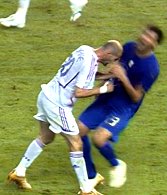
Italia Wins the World Cup: What the Hell Happened to Zizou?

Seriously, does anyone know what pissed Zidane off so thoroughly that the did this? Did Materazzi say something heinous? What? It's hard to make sense of this action given how seasoned of a player Zidane is. One of my friends actually switched alliances to Italy after seeing that unprofessional behavior. Still, I have to wonder why when the game was still 1-1 that Zidane would do this, get red carded and then walk off the field. A sad way to end his career indeed.

As for Cannavaro taking his World Cup to bed, boy what I would've given to be that trophy for one night!

UPDATE: Guardian speculates that it was a racist slur. If so, what do you think?
UPDATE #2: Lindsay switched alliances too after Zidane's headbutt.
UPDATE #3: Le Monde considers different rumors about what Materazzi said, e.g. that he called Zidane a terrorist (this article is in French).

Sunday, July 09, 2006

Gender Stereotypes=Good Marketing at Colleges

The NYTimes today has a front page story, which is the first of a series on The New Gender Divide, analyzing why women are outperforming men in college and what colleges are doing or not doing to maintain gender parity. Interestingly, American University has done nothing, and therefore has tilted to a majority of female students. On the other hand, Dickinson College--one that I know well--has put a great deal of effort into recruiting more men and admitting more men (who may not be as qualified as the women) in the name of "diversity."

I have written before about the issue of admitting more unqualified men to college in the name of gender parity. I am not sure I have anything fresh to say about this piece, other than to reflect a bit on the strategy of Robert Massa, Vice President for Enrollment at Dickinson College.

Robert Massa, vice president for enrollment, began campaigning for more male students shortly after he arrived at Dickinson in 1999 and discovered that only 36 percent of the incoming freshmen were male and that the college had accepted 73 percent of the women who applied, but only 53 percent of the men.

Dickinson adapted to the growing female majority by starting a women's center, adding a women's studies major and offering courses on Jane Austen and Virginia Woolf.

In his effort to attract men, Mr. Massa made sure that the admissions materials included plenty of pictures of young men and athletics. Dickinson began highlighting its new physics, computer science and math building, and started a program in international business. Most fundamental, Dickinson began accepting a larger proportion of its male applicants.

"The secret of getting some gender balance is that once men apply, you've got to admit them," Mr. Massa said. "So did we bend a little bit? Yeah, at the margin, we did, but not to the point that we would admit guys who couldn't do the work."

Longtime Dickinson administrators say that at isolated campuses with their own social worlds, gender balance is especially important.

"When there were fewer men, the environment was not as safe for women," said Joyce Bylander, associate provost. "When men were so highly prized that they could get away with things, some of them become sexual predators. It was an unhealthy atmosphere for women."

In education circles, Mr. Massa is sometimes accused of practicing unfair affirmative action for boys. He has a presentation called "What's Wrong With You Guys?" in which he says that Dickinson does not accept a greater proportion of male than female applicants, and that women still get more financial aid.

Where to start? First of all, I hope that the Times sort of screwed up the reporting here. I want to believe that what fuels Mr. Massa is not the fear that fewer men means more danger for women (as Bylander suggests), but rather a need to keep attracting those talented women, who want to come to a college with men they can date. If it is the former, then it is part and parcel of a persistent paternalism among college administrators that I cannot abide (in loco Patriarch!). I can just imagine the pitch to parents:

"Well, as you know, women are outperforming men in high school and therefore are admitted at higher rates to colleges and universities nationally. However, we find that when there is no gender parity, the men who are accepted behave badly to the female students, because, well they can. So, to fix this problem, we are launching a huge campaign to attract more male athletes to campus, with an eye to nurturing better relations between the sexes!"

What?

While I don't doubt that fewer men means that those men can become bigger assholes because they are more prized, it seems like shoddy logic to admit more men to protect the fragile-hot-house-flower women. Are these women more vulnerable in Central Pennsylvania than they are at American University, which maintains gender-blind admissions?

I also find it depressing, which is different than being outraged, that Dickinson consciously features their Physics, Math and Computer Science Programs to attract more men. While it is surely the case that men are still more likely to major in these subjects than women are, it seems depressing to me that they are playing to that strength to get more men on campus, and thereby reinforcing unfortunate stereotypes that these subjects are better suited for men rather than women. I am equally depressed, btw, that Dickinson's response to a higher number of women was to start a Women's Studies minor, Women's Center and teach courses with Woolf or Jane Austen. Is it really true that faculty used the fact of higher female enrollment to justify these programs? No faculty were teaching courses on women's writers before the female enrollment boom? And, if that is true, does that mean the converse is true: namely, that all courses and programs one would find in colleges before women started outpacing men were designed to keep men's interest and attract men to the colleges? So anything pre-women's movement is a relic of a time when colleges competed solely for men's interest?

Finally, if Dickinson is truly concerned about the danger their young women face on campuses with fewer, and thereby highly prized men, then why does reinforcing gender stereotypes actually fix the problem? Do you really want to get more male athletes to improve gender relations on campus? I don't follow the thinking here at all.

What do the rest of you, my male and female readers, make of this new trend story, wherein men are suffering in schools, women are excelling and we think this is a bit of crisis? What is the best approach to better engaging male students?

Above all, is gender parity a "good" in itself?

Friday, July 07, 2006

Why the Uckiness over Using Prozac for Enhancement?


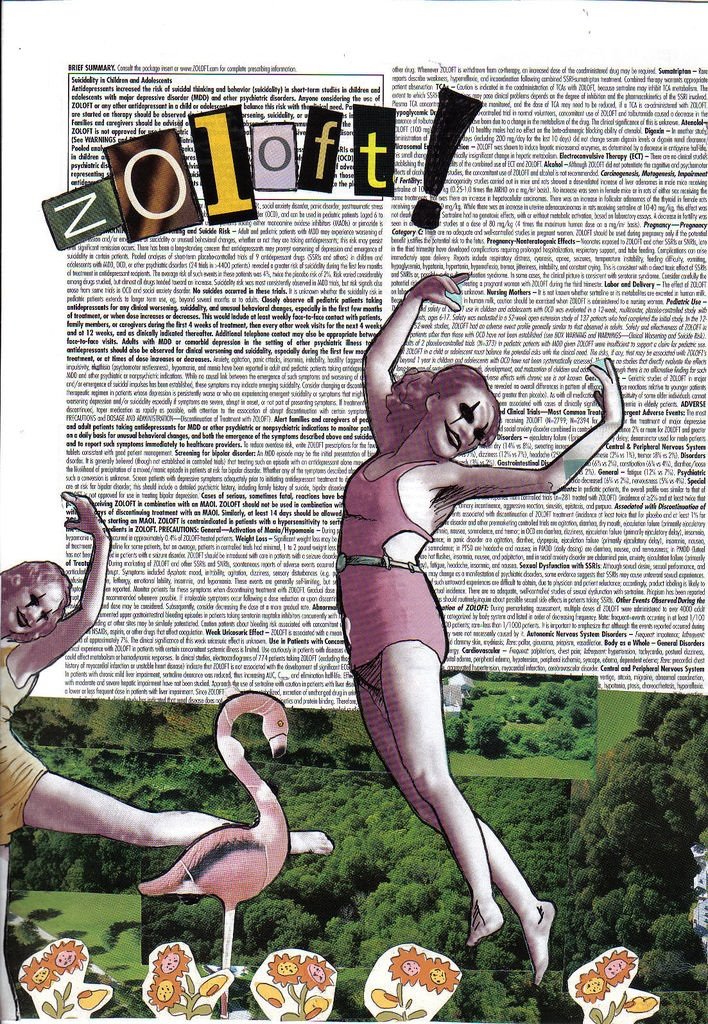
Those of you who read my blog regularly know that I am working on a book wherein I take a serious look at the practice of taking SSRI drugs for enhancement purposes. That is, is it morally permissible to take Prozac to give me an edge in the marketplace?

Peter Kramer argued, in his 1993 book Listening to Prozac, that many of his patients (mostly women) who were made anxious in a man's world were better off once they took Prozac. They were less anxious, needy, and above all, less sensitive. If you study carefully the drug advertisements for SSRIs, inevitably you see them pitched for soccer moms who are stressed out by competing demands of childcare and work deadlines. The drug ads are designed to encourage women, who are always good consumers, to consider thier stress to be not so much a product of unbearable social expectations, but rather a neurochemical failing (see Jonathan Metzl, "Selling Sanity Through Gender."). These drug ads are really just part of a larger trend of selling "lifestyle ailment" medications (Viagra, Propecia, Cialis, Prilosec . . .) (see Carl Elliott, Better Than Well).

Now, I have always found Kramer's question, namely what is wrong with Cosmetic Psychopharmacology (taking SSRI drugs to feel better than well)?, to be intriguing. What interests me is that most people seem to find this practice repugnant. Imagine you were to say to your friend: "Well, I used to be stressed out all of the time at work because the alpha-male environment is pretty brutal. But, now I take Prozac and I just don't give a shit anymore." What is her/his response likely to be? When I pitch this to audiences, most believe that this is simply wrong. "We should be changing the workplace," they argue. Or, "what about therapy, or yoga?" Anything but taking a pill to solve these structural problems seems preferable. But why? Why is it better, I ask you, to do Yoga than take a pill?

Put This in the File of Why Feminism is Indispensable

Hanno sent me this article on "breast-ironing" in Cameroon, which serves as another obvious reminder why feminism is far from irrelevant. CNN reports:

The practice is now more common in urban areas than in villages, because mothers fear their children could be more exposed to sexual abuse in towns and try to suppress outward signs of sexuality, the survey said.

Its findings have prompted a nationwide campaign to educate mothers about its dangers and to try to eradicate it. A similar campaign some years ago helped drastically to reduce rates of female genital mutilation in Cameroon.

"A girl...has to be proud of her breasts because it is natural. It is a gift from God. Allow the breasts to grow naturally. Do not force them to disappear or appear," said a leaflet from the campaign.

I imagine that many people, who are not hip to feminist thought, might read this report and assume that the real enemies of women's rights to bodily integrity are their own mothers. Certainly many folks who read about FGM, and now breast-ironing, are perplexed over why these 'cruel' mothers inflict such harm on their daughters. What feminists will be perplexed over is the message of the public campaign aimed at educating women not to iron their daughter's breasts. Certainly the message is aimed at the wrong audience, since it is the men, who are raping these young girls, that need to respect these young girls and their developing bodies.

To tackle the first issue--why do the mother exact such painful cruelty on their daughters--we need to rely upon some sort of notion of 'patriarchy.' Feminists have grappled for decades over how to depict this psychological oppression that uses women as the very instruments for controlling female sexaulity. While in the mainstream here in the United States we see less obvious examples of this corporeal mutilation directed at controlling female sexuality, we do have more subtle and insidious examples of how women are employed to control other women sexually. One example, would be this rather inefficacious slide show. Other examples include the welter of slurs other women are willing to heap on each other: slut, ho, skank, uppity, bitch . . .

Many contemporary feminists have turned to the work of Michel Foucault, notably Sandra Bartky, to illustrate the subtle ways that dominant groups (patriarchy) subjugate, quite bodily, subjects they wish to rule. Bartky ("Foucault, Femininity, and the Modernization of Patriarchal Power") has a fascinating analysis of "disciplinary practices (see definition of disciplinary power in linked page)" of femininity, highlighted in the study of beauty practices like electrolysis, skincare, makeup, fashion (stilettos!) and diet. Certainly other women are great instruments for pressuring all women to submit to these often painful practices. Our mothers, in fact, regularly get on our cases if we gain a little weight, or don't take care of our appearance. Why do they do it? Are they merely critical? No. They fear the repercussions of not submitting ourselves to these beauty practices; we will be called---gasp!--man-hating feminists (see Echidne today). ***(A bit of digression: this morning I watched the Washington Journal on C-SPAN. One of the reporters, Pamela Hess, was rudely taken to task by a male caller, who assumed she was a feminist because she was not as dolled up as the other female reporter. The second reporter probably dolls herself up for such interviews to hold at bay precisely those comments. My former professor called this "putting on your armor.")***

Anyway, my point here is that what we take to be outrageous and egregious acts of female mutiliation, in the service of patriarchy, have been merely updated and modernized here in the United States. Sure, we don't iron our daughters breasts, but we do try to keep them looking pretty so they won't be made fun of or picked on in school. The time invested in keeping yourself pretty is time taken away from developing a rich, vibrant self. What feminists are charged with, in this day and age, is tracking the way that patriarchy continually adapts to its environment. What one hopes is that by tracking this beast, we can defuse its power over us. How?, is an open question. Some women do so by exaggerating the very expectations of feminine beauty they are supposed to adopt, thereby making fun of these demands. Others simply refuse to participate in the disciplinary practices of beauty or disallow moralistic slurs heap upon them by other women to stifle their "liberated" behavior. Whatever path you take, the way out of patriarchy is less than clear. No matter how much you reject the beauty world in the U.S., you will still suffer from failure to participate.

It behooves all feminists to not only fight these acts of female sexual oppression in Cameroon, but to remember, while doing so, that we are far from free of these same, but muted forces, in our our backyard.

Thursday, July 06, 2006

Use Condoms


Now, this commerical, originally shown in Germany, is far more productive towards sane sex talk policy. And, it is damn funny. Shit, it works for me.

Isn't This Getting You Hot?

Society's Unsighted Fasination With Sex in the Media


Via Pandagon, I found this video slide show promoting abstinence only. I can't quite make sense of the audience for this bit o' propaganda. If it's horny young kids, I am afraid you are going to lose them in the first few seconds when they will be sufficiently titillated to get naugthy. If it is the parents of these naughty kids, then clearly they are out of synch with popular culture and when they see this slide show they are destined to lock their children up, if of course they haven't already fainted from these juicy images. But in either case, this video gives all the wrong signals about how we should be talking to young people about sex.

You cannot expect to titillate and then say "no, don't do that!" When has this approach ever been successful? Furthermore, what does it mean that looking at these sensual and sexual images titillate in the first place? Should we pretend that we are not sexual beings? Are we really suppose to channel all of that wonderful energy and passion into the task of raising good Chrisitan children? Our sexuality is as much of gift to celebrate as any other. Sure, we can get too much of a good thing, but that is where I would start the conversation . . .

Shame on You Ann!

Have you heard the latest? Ann Coulter has lifted whole paragraphs from other sources without bothering to give a single footnote. If she were a student in my class I guarantee you that she would receive an F for the class. And, given her repeat offenses, she would be kicked out altogether. Plagiarism is a serious offense in the realm of academia; I hope that others realize how egregiously wrong this is. When I lecture my students on why one should never plagiarize, I have abandoned the "it's cheating" approach. The reason "it's cheating" doesn't work is because students don't care if they think that all they are doing is "cheating themselves." They have heard the old saw: "you're shortchanging your education when you cheat," and they toss it aside since many of them are far more freaked out about their future employment, scholarships, law school applications. Their focus on success overshadows any thought to actually learning something, or better yet, establishing their credentials as trustworthy writers, who have a fresh voice, and make reliable and therefore persuasive arguments.

Hence, I point out to my students that when they cheat they are personally insulting me as their professor. Some of them might not give a shit. But, those who do ask, interest piqued, why they are insulting me. "Because when you cheat, you are implicitly saying that you don't think I am smart enough to know that you are quoting someone else's work, work, btw, that I am more likely to know than you do. Furthermore, when you cheat, you assume that I don't read carefully your work and know what you are capable of writing." This gives them some pause, but, I can't say how much this affects their attitude toward plagiarism.

My little lecture on why you shouldn't plagiarize holds for Coulter too. By lifting whole paragraphs from Planned Parenthood or the L.A. Times you are signalling to your reader that you think they are so dumb, so gullible that they will blindly believe your authority on these matters. One of the reasons you cite the work of others is to make your arguments as transparent as possible. If you are taking evidence from another source, you want to send your readers to that source so that they can evaluate its merits rather than just trust you. If you are quoting your opponent's position in order to refute it, why not let the reader know that you are, in fact, quoting their work, rather than leave them to assume you are well equipped to summarize their position? Be charitable for chrissakes!

By properly citing others' you actually strenghten your own arguments. You show respect to your readers by giving them the tools to substantiate your claims all on their own. Those who routinely plagiarize are either arrogant--they believe that no one will question their credibility--or stupid--they think it is perfectly ok to cut and paste other folks words into your own columns. I think it is safe to say that in Ann's case, she is both.

Boy, I bet she regrets this moralistic piece (cached Google page) she did on Jayson Blair.

UPDATE: Shakespeare's Sister has something on Coulter's response. Here's the New York Post story on Coulter's plagiarism.

Wednesday, July 05, 2006

Ken Lay, Dead

This just in, via SteveG, Ken Lay died last night. No details yet, except that his lawyer said it was a heart attack. Hmmmmm . . . .

Italia: 2-0!

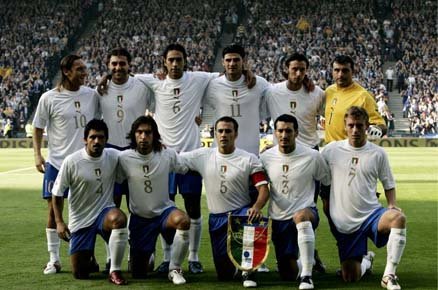
As Alessia noted in the comments to one of my other posts, Italy beat Germany yesterday, 2-0 in overtime. It was a hell of a game and I am usually too ADD to focus on the games. But, now I am hooked. Yes, I am one of those Johnny-Come-Lately types to most sports events. But, I gotta say Italy has a great team, despite what the recent New Yorker article had to say ("Un-American Activity: The World Cup and Our Problem with Soccer" by Jeffrey Toobin). Fabio Grosso's goal was stunning. Then, when Del Pietro's scored in the last minute of the game, I thought, Germany had given up. How could they let that second goal happen?

Before Italy scored I was ambivalent about either team. I was born in Germany and felt some pride for my birth country, but the best year of my life was spent in Rome. I am not sure that either of those facts are good bases for being a fan, but who ever really does have a good reason? So, alas, I am now behind Italy. I will be watching France v. Portugal this afternoon as well. I am hoping it comes down to France and Italy. Anyone with a large TV wanna invite me to watch the final game on the 9th? (Hint: Jamie!)

I must admit that I have pathetic girl crushes on both Del Piero and Hottie Fabio Cannavaro. My willingness to admit this lead my friend Philip to tell me that this is precisely why American men don't like soccer: "it's a pretty boy game" he said. So be it. Check out these pictures of Cannavaro at the Most Beautiful Man website. (Alessia, I mean you!)

UPDATE: I am listening to the ESPN commentary on yesterday's game and man, Americans are ruthless in their reception of football (soccer). Sure, Italians are famous for their high operatic drama when someone smacks into them, but it is strategy, duh! The ESPN dude basically says: "Soccer players are not the toughest guys." Then, his commentary on Grosso's goal (if you saw this, Grosso starts running down field shaking his finger): "Don't touch me, I want everyone to know that I scored this." Toobin is right on: Soccer is the Un-American Activity. But, alas, I was one of those suburban kids growing up in California who played my whole life.

UPDATE #2: Yes, I am so pathetic. I just found this website the ranks the hottest Footballers.

Tuesday, July 04, 2006

Fidelity to Liberty

Today calls for a more meditative post on what I am celebrating on Independence Day. I want to celebrate two important documents today, which I believe are the very best of what this country stands for and what I return to again and again when I fear that the powers that be in Washington want to ignore or dismiss the import of these documents. Alas, today I celebrate the Declaration of Independence and The Constitution of the United States. I am grateful for the vision of the Declaration of Independence in declaring:

We hold these truths to be self-evident, that all men are created equal, that they are endowed by their Creator with certain unalienable Rights, that among these are Life, Liberty and the pursuit of Happiness. — That to secure these rights, Governments are instituted among Men, deriving their just powers from the consent of the governed . . .
This is a document born from the Enlightenment; here we have the expression of fundamental truth, which is the sole basis for our current form of government--a government whose powers are drawn from the consent of the governed. While as a philosopher I have engaged in countless hours of debates over whether or not we can actually know that human liberty is in fact a self-evident truth, I am still passionate about this declaration. I am willing to interpret it less as a absolute truth, but rather as an axiom. Lincoln's Gettysburg Address adopts the axiomatic language when he says

our fathers brought forth, on this continent a new nation, conceived in liberty, and dedicated to the propostion that all men are created equal . . . (my emphasis)

Now my dear colleague SteveG will have to give you a better lecture than I could of the difference between a "self-evident truth" and an "axiom" for logicians and mathematicians. However, the gist is that axioms do not require elaborate metaphysical arguments (a la Thomas Aquinas) dedicating to proving they are absolutely true (i.e. Proof of God's Existence). Lincoln's language belies this when he says we are dedicated to the proposition that all men are created equal. We have conceived of this nation that honors each human's fundamental liberty because we assume all humans are equal.

It is precisely this language, of the Enlightenment, that inspired the first wave of feminists, such as Susan B. Anthony and Elizabeth Cady Stanton, who penned the Declaration of Sentiments, which used the same language, invoked the same axiom--all men and women are created equal--in order to frame the moral and political right to suffrage and equal rights under our constitution. Granted the Declaration of Independence does not use the language all men and women are created equal, but is rather difficult to make a case, unless you hold to a very unEnlightenment religious worldview, that women are not also contained int his propostion. Stanton and Anthony simply highlighted that fact.

What also gives me comfort in these dark days of the Bush Administration is the following paragraph, near the end of the Declaration:

In every stage of these Oppressions We have Petitioned for Redress in the most humble terms: Our repeated Petitions have been answered only by repeated injury. A Prince, whose character is thus marked by every act which may define a Tyrant, is unfit to be the ruler of a free people.


Indeed it seems we have among us a prince who is a tyrant.

I said I wanted to honor two documents and so I hasten to give thanks also to the U.S. Constitution. I couldn't possibly enumerate all of the features of this important political document that I revere in this post. I will focus on two aspects--the supremacy clause (Article VI, paragraph 2) and the 5th Amendment. Article VI, paragraph 2 clearly states:

This Constitution, and the Laws of the United States which shall be made in Pursuance thereof; and all Treaties made, or which shall be made, under the Authority of the United States, shall be the supreme Law of the Land; and the Judges in every State shall be bound thereby, any Thing in the Constitution or Laws of any State to the Contrary notwithstanding.


I am grateful for this clause of the Constitution because it protects each citizen from the state and local governments who might impose their own private moral views or political prejudices on citizens. States and local governments quite simply cannot make laws that deny any citizens civil liberties. (Thank goodness for the ACLU, who vigilantly protects our civil liberties.)

Lastly, I have learned this year the profound importance of Due Process, articulated in the 5th Amendment:

No person shall be held to answer for a capital, or otherwise infamous crime, unless on a presentment or indictment of a Grand Jury, except in cases arising in the land or naval forces, or in the Militia, when in actual service in time of War or public danger; nor shall any person be subject for the same offence to be twice put in jeopardy of life or limb; nor shall be compelled in any criminal case to be a witness against himself, nor be deprived of life, liberty, or property, without due process of law; nor shall private property be taken for public use without just compensation.
There is a lot to muse on in this amendment. But above all, it symbolizes for me how seriously we take the proposition of human liberty. We extend dignity and fairness even to those whom we believe might have broken our laws or intended to harm us. We give these men and women the benefit of the doubt and grant them a fair trial. We do not (or SHOULD NOT) just round up anyone suspected of wrongdoing, throw them into jail, torture, maim, or kill them. Such actions are the very antithesis of system of government and our dedication to human liberty. We treat our alleged enemies with the same dignity and respect that we demand our government to honor us with. This is what distinguishes our form of government and only by fidelity to this principle can we with great pride celebrate this Independence Day.

Monday, July 03, 2006

Fun Little Email Meme

I broke my hiatus only to post the answers I typed to this meme my mom sent me via email. It is sort of fun to fill out and have others mail back their answers. I should be doing work today, but I am so susceptible to distractions when it is sort of a holiday. Here goes:

1. FIRST NAME? Aspazia. But lots of folks call me 'Spaz here.

2. WERE YOU NAMED AFTER ANYONE? No, cuz it's a pseudonym. (But, it is a purposeful misspelling of a famous Greek courtesan). I don't think my real name is a namesake.

3. WHEN DID YOU LAST CRY? Two nights ago watching Hitch. I have no explanation for why I do this during sappy movies or TV commercials. It is so embarrassing. I have a hard time crying about anything in my life, but put on Oprah and here come the water works.

4. DO YOU LIKE YOUR HANDWRITING? Only when I am using certain pens. In fact, my handwriting looks best when I am using those crappy pens you get from motels/hotels. Otherwise, my handwriting is totally illegible. I have spent too much time typing to rescue it.

5. WHAT IS YOUR FAVORITE LUNCHMEAT? Either roasted Turkey or a chicken breast (preferably marinated in something fabulous!)

6. KIDS? Not yet. I have a very cute beagle named "Marty" who fools you with his sweet face (cuz he is really the Devil). But, he snuggles up with me on the couch.

7. IF YOU WERE ANOTHER PERSON WOULD YOU BE FRIENDS WITH YOU? Hell yeah! I am very easy to hang out with (although highly organized people get frustrated with me). I am funny, love to entertain, and a great shoulder to lean on. I also am pretty darn spontaneous, which appeals to me, but perhaps not others?

8. DO YOU HAVE A JOURNAL? I start and stop journals all the time. I use them to get through a crisis or anxious time. When I start to feel better I don't write so much. My journal then becomes a repository for all my notes for things to write professionally.

9. DO YOU USE SARCASM A LOT? Um, yeah? I have no other means for coping with lame ass students sneaking into class late or trying to convince me to give them another day for their already late, late paper.

10. DO YOU STILL HAVE YOUR TONSILS? No (thanks to my parents who couldn't stand my snoring!)

11. WOULD YOU BUNGEE JUMP? I doubt it. But, you never know with me. In the right context I could probably be cajoled to do it!

12. WHAT IS YOUR FAVORITE CEREAL? Anything with lots of nuts, flakes, and fruit. (I'm from California, what do you want from me?)

13. DO YOU UNTIE YOUR SHOES WHEN YOU TAKE THEM OFF? I can't think of a single pair of shoes I have with laces. I used to have running shoes, but gave up running for Yoga, which I can do barefoot!


14. DO YOU THINK YOU ARE STRONG? Physically or emotionally? I am in decent shape physically from doing hours and hours of yoga. However, I have lower back problems (disk surgery and hence some arthritis). Za (my significant other) can usually handle what I can't move if I look pathetic. Emotionally, I would say I am pretty strong. I am much better handling other peoples' crisis than my own, but I am working on that. In the end, I get my shit together.

15. WHAT IS YOUR FAVORITE ICE CREAM FLAVOR? Peanut Butter and Chocolate Ice Cream from Baskin and Robbins.

16. SHOE SIZE? 10

17. RED OR PINK? Pink. Despite my fierce feminista ways, I love, love anything Pink. It is such a happy and playful color.

18. WHAT IS THE LEAST FAVORITE THING ABOUT YOURSELF? My high anxiety levels before I have to make a presentation and my ridiculous case of procrastination. I write almost everyday, but never the things I should be writing. Go figure.

19. WHAT DO YOU MISS THE MOST? Living in Boston in the early 1990s when you could afford rent, life in Rome, and big family gatherings.

20. DO YOU WANT EVERYONE TO SEND THIS BACK TO YOU? Absolutely!

21. WHAT COLOR PANTS AND SHOES ARE YOU WEARING? No pants. I am wearing a tan linen skirt that I just bought on sale at Banana Republic and cheap Long's drugs flip flops.

22. LAST THING YOU ATE? Cereal and yogurt.

23. WHAT ARE YOU LISTENING TO RIGHT NOW? The whirling of blenders preparing ice lattes for customers in the café I am working in.

24. IF YOU WERE A CRAYON, WHAT COLOR WOULD YOU BE? Lavender.

25. FAVORITE SMELL? See # 24

26. WHO WAS THE LAST PERSON YOU TALKED TO ON THE
PHONE? USSA Home Owner's Insurance Agency (trying to get some reimbursement for the flood damage).

27. THE FIRST THING YOU NOTICE ABOUT PEOPLE YOU ARE ATTRACTED TO? Eyes, smile, easy going spirit, and humor.

28. DO YOU LIKE THE PERSON WHO SENT THIS TO YOU? Of course, my mommy sent it to me. I love my mommy.

29. FAVORITE DRINK? A full glass of fruity red wine (Pinot Noir, Pinot Meunier or Old Vine Zinfandel).

30. FAVORITE SPORT? Soccer (Football for non-Americans). The only sport I truly enjoyed playing before it destroyed my knee.

31. EYE COLOR? Hazel.

32. HAT SIZE? I have no idea?

33. DO YOU WEAR CONTACTS? Yes. But I get sick of wearing them all the time.

34. FAVORITE FOOD? French cuisine!

35. SCARY MOVIES OR HAPPY ENDING? Happy endings--I need some balance to my often unhappy ending life.

36. LAST MOVIE YOU WATCHED AT THE MOVIES? Kinky Boots. (So cute!)

37. WHAT COLOR SHIRT ARE YOU WEARING? White.

38. SUMMER OR WINTER? Summer. Duh! I don't have to teach.

39. HUGS OR KISSES? Hugs.

40. FAVORITE DESSERT? Rich, flourless, chocolate cake where the inside oozes out.

41. WHO IS MOST LIKELY TO RESPOND? No clue (depends on who is avoiding work as much as I am).

42. LEAST LIKELY TO RESPOND? Za and my brother.

43. WHAT BOOKS ARE YOU READING? Gideon's Trumpet.

44. WHAT'S ON YOUR MOUSE PAD? Painting of the Louvre (a gift from my brother).

45. WHAT DID YOU WATCH ON TV LAST NIGHT? Nothing.

47. ROLLING STONE OR BEATLES? Beatles.

48. THE FURTHEST YOU'VE BEEN FROM HOME? Egypt (like my mom).

49. WHAT'S YOUR SPECIAL TALENT? Being there for my distressed friends. Ok, and teaching.

50. WHEN AND WHERE WERE YOU BORN? August 15, 1970 in Frankfurt, Germany.

51. WHO SENT THIS TO YOU? My mom.

Friday, June 30, 2006

Brief Hiatus

I am taking a few days off from the blog to tend to a flooded basement and to readjust to EST. Unfortunately the heavy rains flooded our basement and I have spent the last two days rescuing what I can and throwing lots and lots of stuff out. It's amazing how a flood can clean you out (he he).

Anyway, I hope all of you enjoy your 4th of July weekend and I will see you next Tuesday! ;)

Feel free to make this a discussion thread . . .I might peek in to see what folks are saying.

Thursday, June 29, 2006

Nagging in the Animal Training Approach to Marriage Age

Via Lindsay, I discovered this true gem from the NYTimes: "What Shamu Taught Me About a Happy Marriage." I laughed through the whole piece. The author describes using techniques for training exotic animals on her alpha-male American husband. The core insight is that if you want your husband to stop dropping dirty clothes on the floor, leaving a mess of papers all over the surfaces of the house, or crowding you in the kitchen while you try to cook, then stop nagging and start rewarding the behavior you like.

Intuitively, this makes perfect sense. Just recently I had a similar epiphany in relation to a relative. I realized that this relative was not going to stop using all sorts of guilt inducing behaviors and so, rather than get upset at it, I decided to only reward the good behavior. I simply ignored the annoying behavior. It worked like a charm for my mental health, and perhaps over time it will smooth over our rather strained relationship. Sutherland writes:


I followed the students to SeaWorld San Diego, where a dolphin trainer introduced me to least reinforcing syndrome (L. R. S.). When a dolphin does something wrong, the trainer doesn't respond in any way. He stands still for a few beats, careful not to look at the dolphin, and then returns to work. The idea is that any response, positive or negative, fuels a behavior. If a behavior provokes no response, it typically dies away.


Sutherland also points out what should be obvious to all of us: nagging does not work. I have always hated turning into a "nagger." Just the other day I was riding back from the airport with my friend and talking about relationship stuff. We were talking about the different thresholds that men and women have for messiness. He then asked me if I was a "nagger." I admitted that at times I have had to resort to nagging, particularly with important things like: send this to X company or call X person back. But, defensively, I said: I hate "nagging." I don't want to be one. But, if I don't do it, I have only two options left to me: (1) accept that major and minor decisions/tasks that my partner doesn't want to do, but that can negatively impact me, will not get done or (2) Do them myself. Neither of these options seemed all that attractive. I also pointed out how much I resent having to "nag," since I don't understand why he would trust me to take over so many of the important tasks. Afterall, what if I screw him over?

That was when Josh said something quite soothing: you are not nagging. When you remind him to do things that he either doesn't want to do, or didn't anticipate, or didn't remember to do, you are helping clue him into what is important to you to get done. You are reminding him. Ok, maybe I am reminding him. But, part of me smolders when he doesn't anticipate things that I would. But, Josh made plain that would never happen. So, I could spend the rest of my life annoyed, or I could positively reassess what I had negatively framed as "nagging." I am not sure if what I am doing is nagging or being helpful. My own attitude to what I am doing, however, might be harsher than the reality of my action; my dogged desire to not be someone's mother might be clouding my perception of what is actually happening. Afterall, Josh is probably right that I am more attuned or better skilled at some things that my partner isn't skilled at, so sharing those skills and helping him get things done need not devolve into mere nagging.

Josh's more important insight, however, was that I shouldn't be suspicious or judgmental that my partner trusts me to handle some of the important aspects of our relationship. I thought, however, that he shouldn't trust me, but rather go over everything I plan, or every document we sign. I knew that he has been burned before when he trusted another. And, frankly, I have always been mistrustful of others handling important affairs. Alas, what I was perhaps missing is that my partner's trust in me could, in fact, be a sign that he is a good guy. I don't have to frame it as he is a dolt, or careless. Sutherland points out:


I used to take his faults personally; his dirty clothes on the floor were an affront, a symbol of how he didn't care enough about me. But thinking of my husband as an exotic species gave me the distance I needed to consider our differences more objectively.


Alas, the daily misunderstandings between romantic partners need not be taken so damn seriously. In fact, perhaps what this article demonstrates is the final death of psychoanalysis or talk therapy. The idea that we have to read into every little action or inaction of our partner is a waste of time; we don't have to mine these actions for some deeper story of their earlier abandoment. Why not just give them some radishes to chop for the salad while we prepare dinner so they won't crowd us in the kitchen.

Btw, once Za reads this, I am sure he will begin to hatch plans for training the irritating behaviors out of me.

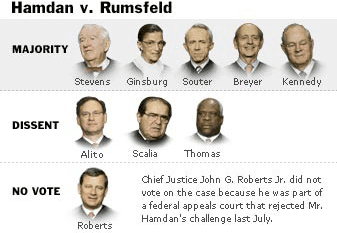
Thomas Speaks . . .


And, alas, Thomas actually spoke from the bench. What did he say on this momentous event:

He said that the ruling would "sorely hamper the president's ability to confront and defeat a new and deadly enemy."


Wow, a revelation! I have never heard such sage words before. Do the RNC talking points get faxed to the SCOTUS folks?

While I am grateful for this ruling, I am sick and tired of the particular reasoning in defense of military tribunals, illegal surveillance programs and torture that argues we need to give maximum power to the President to fight terrorists. The terrorists have already won when this administration thumbs its nose at the international law, federal law, the Consitution, and, let's not forget, morality.

Tuesday, June 27, 2006

Bootleg Boner Pills

Hat Tip: Ralph

UPDATE: Check out Amanda's post on Rush over at Pandagon. Go there just for this line:

How can you tell the difference between unacceptable recreational sex and the good kind? Well, recreational sex is the kind where women do it for fun and not to make babies. It has nothing in common with the sort of pious fucking that the still-childless Limbaugh had in mind when he bought that big bottle of Viagra.

Bitch and the Blow Job Blow up

Read this really brave post, "Let's Talk About Sex," from Bitch Ph.D. This post follows on the heels of the Blow Job Blow up (BJBU)that started with Twisty. Amanda gave a charitable read of Twisty's argument here. Piny, at Feministe, had this less than charitable refutation of Twisty's post. And R. Mildred at Punkass Blog told Twisty to "bite me." Broadsheet does a nice summary of the whole BJBU debacle.

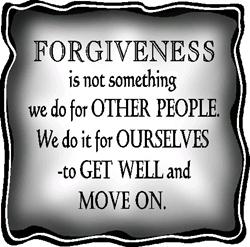
Why It Is Hard to Forgive

I have been travelling quite a bit the last few days--from Maui to Molokai, back to Maui, then from Maui to Phoenix, where I sit awaiting my flight to Baltimore. I had a lot of time alone yesterday, in Molokai, to reflect on things that I don't usually reflect upon. My father travels to Molokai every Monday to treat the islanders there who would otherwise have no quality healtcare. While he and his wife met with patients, I drove around the island, took a walk to see the former leper colony, and finally landed on a beach, where I sat for a couple of hours.

It was during my spell on the beach that I started to think about forgiveness. I don't know about you, but I find forgiveness to be a hopelessly abstract concept. What I was trying to work out in my head was how you can forgive--truly forgive--someone who has wronged you without giving your tormentor the sense that he or she has done nothing wrong. Or, how do you forgive someone without the other believing that, well, you finally came to your senses and realize that you were just being too hard on them? Or, how do you forgive someone without allowing that person to take advantage of you?

These are hard questions for me. And, frankly, no careful arguments seem to sway me one way or another. I believe that this is something more profound--experiential--and therefore all the more murky. I want to forgive some people that have hurt me--and frankly continue to hurt me--but I am not sure that I could ever allow these people to have a significant place in my life. I also worry that my desire to forgive comes from a selfish place. That is, I hope that if I forgive, then I will no longer be weighed down by the anger, the hurt, and the disappointment. I carry that around everyday and I am not sure that it has any purpose. So, I thought if I were to forgive them then I would feel at peace.

Ok, sounds interesting. But, this is still so abstract to me. Why would I feel better if I forgive people who have hurt me? Does something magical happen to my soul that finally frees it from the pain and anger? Or, am I telling myself a story about why these folks did what they did in a way that I can empathize with their weakness and mistakes. The latter seems to appeal to me. It seems possible that I can give some account of the hurtful actions of another in such a way that makes sense of why they made mistakes, why they hurt others, and how this came from a vulnerable place--a place that we all have.

Forgiveness is such an interesting concept. It is not only worth debating when and who we should forgive--are there some we can never forgive? But personally I am struck by how dangerously close my sense that I should forgive is to being moralistic. And by moralistic, I mean believing myself to be above reproach, being better than the Other. This is an uncomfortable place. The discomfort only intensifies my need to forgive; to rid myself of the anger. So, how do we forgive?

If I ask my Dad, he would tell me to pray and ask for help. And the philosopher shakes her head--pray to whom? Why? How will I know if I have been heard? If I ask my colleagues, I am sure one of them will encourage me to be generous, to see that whatever pain I feel, the one who causes the pain is worse for it. Ok, I can buy into that. But, alas, I am still left with a fear that by forgiving, by being compassionate to one who has hurt me, I am somehow letting the Other off the hook. I don't know why I am stuck, but I am.

Saturday, June 24, 2006

Don't Tell Me There are Pro-Choice Republicans!

For years I have heard that there are such folks as "pro-choice" Republicans. Planned Parenthood has tried to drum up their support in the last few years. I have heard one of my friend's mother--who is unquestionably a Republican and Bush supporter--tell me "if Roe was overturned, I would protest." Then, of course, there are lots of young male Republicans that I know, like my brother, who are pro-choice, but ignore that this administration is anti-choice, consoling themselves that "they will never be able to overturn Roe." Nevermind that South Dakota has already banned all abortions, Missouri and Louisiana are in close second, and Alabama, Mississippi, Georgia, Indiana, Kentucky, Ohio, Oklahoma, Tennessee and Virginia have introduced bills to ban almost all abortions. Many other states have trigger laws ready, in the case that Roe is overturned. So, where are these "pro-choice" Republicans?

I have read two things recently that has convinced me that there are no pro-choice Republicans. First, feministing reports that George W. Bush has finally broke his silence about contraception and says he supports it for people who are responsible. Secondly, in the comments thread to my last post, Hanno writes:

But you will discover that most people who work in the party are way left of center. They go to the center because that is where the votes are. Same is true of the Republicans. Most are way right of the center, but they go to the center, because that is where the votes are.

And, it hit me, like a ton of porky pundits: Republicans who claim to be pro-choice are only pro-choice when they are considering other well-off, rich people like themselves. In fact, that seems to go for their libertarianism in general. They think that people like them can make best make their own decisions, but when you start talking about the riff raff, well, then "values" talk starts to creep in. Trusting others to be capable of making good decisions extends only to the circle of friends that libertarians hang out with.

Given that Hanno's long experience in party politics has taught him that Republican leaders are actually right of center, I think its time we give up trying to appeal to the "pro-choice" Republican vote. In fact, this slow coming realization on my part has once and for all cleared up for me why my brother can so cavalierly vote away my rights: he figures that since I am the right sort of person, nothing bad will happen to me. Who cares what happens to those less sophisticated, uneducated, non-white, poor people. That is it, in a nutshell: Republicans simply do not care about poor people. Don't even try to convince me that you do.

Next time you meet a "pro-choice" Republican, just remember, they might care about their own choice, but they could give a rat's ass about yours.

Thursday, June 22, 2006

Better Living Through Chemistry

Ataraxia promotional drug film (1950s)

Of all the states of this nation, by far the happiest is relaxation.

"Lord, make me chaste, but not yet!":Self-Hating Anti-Abortionists

In the wake of news that Democratic Governor, Kathleen Blanco, signed yet another state ban on abortions, I am trying to make sense, once again, of the pro-life position. It is clearly not just a Republican political position, as The (liberal) Girl Next Door explains. Last summer, when I was taking my budding NOW chapter to the grassroots, at various county fairs, I was stunned to see the local Democrats set up their pro-life tent. I felt betrayed, sold out, and repulsed by my local party. In fact, I am not sure what party, if any, I still belong to after that incident. If you live in small towns like mine, or in very rural parts, you will soon realize that the Democratic party is not balm to a soul like mine. The only difference between Democrats and Republicans in my parts is that the former love Social Security and support unions, while the latter is completely pro-market. The "values" of both voters (and yes I did mean to put that word in scare quotes) is indistinguishable. These are conservative folks: very patriotic, traditional families, anti-immigration, pro-gun and pro-life. This makes a feminista like me spin her head. Afterall, I hail from God's Country: California. I would prefer hanging out with a Californian Republican over a Pennsylvanian Democrat (Philly Democrats are the exception) any day of the week.

There are lots of arguments I could make about why I find social conservative politics not only repulsive, but down right immoral. But, I will try to refrain from such a bilious outpour and focus, once again, on abortion. I think that The (liberal) Girl Next Door is onto something when she writes:

what if we stopped engaging in the debate about abortion rights on the Republicans’ terms and started defining the issue for ourselves? We all know that abortion gets the religious right out to the polls, but we also know that Republicans have no real interest in outlawing abortion on the national level, if they did, they could have done so already. What the Republicans want is to have the option of taking the moral high ground while doing nothing other than paying lip service to the abortion issue. Why don’t we take that issue away from them and put them on the defensive for a change?

Beautiful! Seriously, I can't tell you how many "pro-life" Republicans I know, particularly men, who would never deny their mother, sister, aunt, or daughter the right to get an abortion in any circumstance. We know full well from studying history that the moneyed folks have always procured abortions, even if they publically rejected abortion. In fact, what is really happening when pro-lifers set up their tents and preach their moralism is a kind of classism and racism. They are rejecting poor and non-white women getting knocked up; they are punishing these women for having sex. And, let's remember, that no one is proposing legislation that would punish men who impregnate women. Men who knock up a woman, who then desperately seek an abortion in the neanderthal states now passing abortion bans, face absolutely NO criminal charges for their part.

And, to further illustrate (liberal) Girl's point, we have this report from Broadsheet which reports on the number of "pro-life" folks who are planning to turn out and vote for state-wide ballot to reject Gov. Rounds abortion ban in South Dakota. Apparently, when pro-life voters finally get what they pay lip service to--a complete ban that criminalizes abortion--they start putting a real face to the women who they are now penalizing. Abortion stops being an abstract moral issue, and becomes utterly real--what if my daughter is raped? What if my suicidal, bi-polar daughter's psychiatrist recommends that she does not continue the pregnancy? What if my mother's health will be seriously comprimised by an unexpected pregnancy in her late 40s?

The pro-life stance is easy to commit yourself to when the image you have in your head of a woman seeking an abortion is a poor, non-white, drug addict who can't keep her legs shut. The pro-life stance is quite simply a MORALISTIC stance; it has nothing to do with difficult moral deliberations that require looking hard at the facts on the ground, at the individual woman's story or situation. For those who don't adopt the pro-life stance as a xenophobic moralistic stance, I wager they adopt the stance as a corrective to their own less than responsible behavior. I had a staunchly pro-life boyfriend once (believe me, very short-lived) who didn't want to use condoms; I have no doubt that he is destined to get a girlfriend pregnant and we will see how staunchly pro-life he is when that happens. For these sorts of pro-lifers, what you see is a kind of guilt-soaked, self-hating moralism: "Lord, make me chaste, but not yet!"

In fact, I regret that I have even allowed myself to call these folks pro-life, since they are anything but. These are anti-sex, anti-poor, non-white women, and anti-compassion folks. They white knuckle themselves in their own unliveable and unrealistic moral rules, rules that they repeatedly break and then punish others for their own sins.