Thursday, June 22, 2006

Can Men and Women be Friends?

I caught the late night rerun of When Harry Met Sally last night, and it got me thinking again about Harry's comment that men and women can never be friends because the sex always gets in the way.

Here is the whole dialogue:


Harry Burns: You realize of course that we could never be friends.
Sally Albright: Why not?
Harry Burns: What I'm saying is - and this is not a come-on in any way, shape or form - is that men and women can't be friends because the sex part always gets in the way.
Sally Albright: That's not true. I have a number of men friends and there is no sex involved.
Harry Burns: No you don't.
Sally Albright: Yes I do.
Harry Burns: No you don't.
Sally Albright: Yes I do.
Harry Burns: You only think you do.
Sally Albright: You say I'm having sex with these men without my knowledge?
Harry Burns: No, what I'm saying is they all WANT to have sex with you.
Sally Albright: They do not.
Harry Burns: Do too.
Sally Albright: They do not.
Harry Burns: Do too.
Sally Albright: How do you know?
Harry Burns: Because no man can be friends with a woman that he finds attractive. He always wants to have sex with her.
Sally Albright: So, you're saying that a man can be friends with a woman he finds unattractive?
Harry Burns: No. You pretty much want to nail 'em too.
Sally Albright: What if THEY don't want to have sex with YOU?
Harry Burns: Doesn't matter because the sex thing is already out there so the friendship is ultimately doomed and that is the end of the story.
Sally Albright: Well, I guess we're not going to be friends then.
Harry Burns: I guess not.
Sally Albright: That's too bad. You were the only person I knew in New York.

Surely this is not an issue for non-heterosexual people. I can't help but think of the Sex in the City episode where Carrie muses over the ethics of having dates with gay men as the allowable exception to monogamy ("all that glitters"). But, is it really an issue for heterosexuals?

Can men and women be friends? I started to think about my male friends. I have some really close ones, but none of them are in relationships. I have often worried that when one of them finally gets a girlfriend, I will be cast aside. I think that intuition is interesting. I have a lot of male colleagues that I would call friends, but there is a different quality to those relationships. They are interactions that mostly take place at work.

Hence, I am left wondering what the rest of you think about this? Can men and women really be friends?

Wednesday, June 21, 2006

17th Carnival of Feminists!

Bitch/Lab is hosting this chapter of the Carnival of Feminists. There is a nice mini Carnival within devoted to sex positive feminism, a camp that I am not sure that I am in, but at least the current carnival hostess is happy to have me in.

Put Away the Prozac . . .

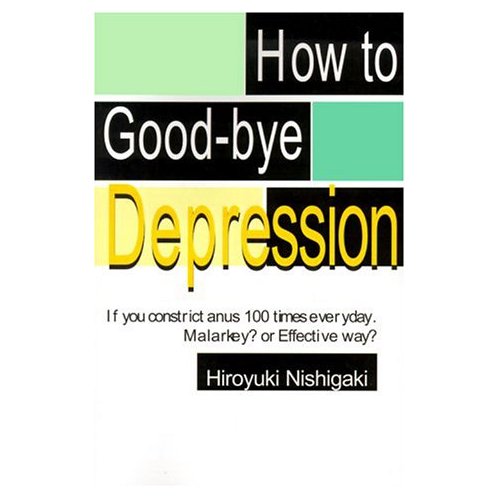
How To Good-bye Your Depression If You Constrict Anus 100 Times Everyday: Marlarkey? or Effective Way?

Now for some reader reviews from Amazon:

Hilarious!! Buy it now!!, April 21, 2001
Reviewer:Brian Williamson "euglena" (Seattle, WA USA) - See all my reviews
I've only had this book for a day or so, and I haven't even thought about reading it from start to finish, but it is pretty gosh darn funny. At the end of the book, the author (Niroyuki Nishigaki) thanks everyone for "finishing reading what I have written in bad English." Bad English indeed! I'll share one of my favorite lines with you and if you think it's funny, I suggest you purchase this book.

"Besides shooting out a big blank from your buttock, you can feel as if your root chakra leaked sweet hot mucus."

That line doesn't make any sense, but it's pretty great. Sometimes I like to open the book up to random pages and read passages for a good laugh. Enjoy!


Constrict Your Anus 2 - "Electric Boogaloo", March 27, 2006
Reviewer:basspeeps "basspeeps" (Seattle, WA USA) - See all my reviews
I can't wait until the sequel to this book comes out - "squeeze your nipples 423 times a day to relieve headaches". Until that time, I must be content with this modern-day Godsend. Originally I have heard that this book was a cast-aside chapter of the New Testament. Apparently, some idiot thought that this wouldn't be prudent as Bible-material. Well, it sure is prudent to me. I've been teaching my dog to obey this book as well. In fact, I'm working on a technique to teach dogs how to constrict their anuses at your command. So useful, really. This book is wonderful. Praise the mighty anus, master of all that is anti-depressent, helpful, brown, and a little stinky.

Hat Tip: Masale Wallah

Belle, the Wunder Beagle


Would a cat dial 9-1-1, I ask?

Tuesday, June 20, 2006

Women Are Depressed Because They Are Oppressed?

Amanda has an interesting mediation on the op-ed from Marianne Legato. I want to remark on two of her points, one of which is a stray comment I want to pick up, and another longer analysis of men and depression.

First of all, Amanda suggests that Legato's piece is a subtly sexist, agreeing with Jill at Feministe, who thinks that if the article claimed that women were the weaker sex it would be consistent with baleful patriachal screeds on women's inferiority. I don't necessarily disagree that there is some subtle sexism in Legato's piece, but I will argue, provocatively, that it is intentional. Now, I have no idea what Legato's motivations are, but I can imagine why someone like her would write a provocative op-ed, that signalled how underserved men are in medical research. I see this as a clever strategy. Let me explain: I am someone whose main line of research is studying why women are overdiagnosed as depressed and subsequently overmedicated. I have given dozens of presentations on what I think is problematic about (a) the criteria for both major and minor depression in the Diagnostic and Statistical Manual of Mental Disorders (DSM); (b) the subtle sexism influencing physicians to see women as mentally ill, rather than reasonably stressed out; and, (c) the greed of the pharmaceutical industry, wanting to sell SSRI drugs to women, who are known to be good consumers and easily manipulated by such advertisements (which play of women's fears of being a good mother, good employee and good wife).

Invariably, when I gave my talks to audience with a large number of male psychiatrists (not hard to do since most psychiatrists are still male), I would be pelted with obnoxious questions (well, they weren't really questions) that suggested I was simply not equipped to understand the complex neuroscience underlying psychiatric research, which illustrated why women are more likely to be depressed than men. Or, I was told that good psychiatrists are not manipulated by the pharmaceutical companies' hype. Or, I was told that the real problem was the General Practitioner's (GPs) who were lax in their prescribing patterns. This sort of response would drive me nuts. The audience would simply throw up a bunch of red herrings to avoid dealing with my argument: we are overmedicating women. So, being a practical feminista, I thought about strategy. How can I get this audience to actually listen to my presentation without either dismissing me as (a) a feminista or (b) a muddleheaded humanities professor ill suited to make sense of scientifically rigorous studies. My solution: change my presentations to illustrate that we are undermedicating men, who are 6x more likely to commit suicide, because we are not carefully examining the folk scientific views of women's overly emotional/pathological nature. By making that simple change in my presentation, I was able to hold off almost all of the obnoxious questions I got before. And, I didn't really change my point. I just got the male audience members to see why they should be invested in challenging the sexism that permeates psychiatric diagnoses and the pharmaceutical advertisements.

Was I selling out? Was I subtly sexist? Maybe. But, it was a pragmatic decision because I am not just theoretically interested in this subject, I want people to take notice of the problem and do something to stop the overmedicating of women. I guess when I read Legato's piece, I imagined she was strategically arguing about men's health issues to illustrate the importance of understanding how gender roles and gender stereotypes are bad for both men and women. Afterall, I think that feminism is not just about empowering women, but rather making life more bearable for everyone. Feminism is humanism.

Now, to the second point. Amanda argues:

One thing about this article bugged me, though.

While depression is said to be twice as frequent in women as in men, I’m convinced that the diagnosis is just made more frequently in women, who show a greater willingness to discuss their symptoms and to ask for help when in distress. Once, at a dinner party, I asked a group of men whether they believed men were depressed as often as women, but were simply conditioned to be silent in the face of discomfort, sadness or fear. “Of course!” replied one man. “Why do you think we die sooner?”

I’m of two minds on this. While I firmly believe that social conditioning about how to handle emotions predisposes women to get better quicker if they become depressed, I’m not sure that men really do suffer from it in the first place as much as women. It’s a numbers thing—depression is, more often than not, caused by having problems. And women have most of the problems that men have that could cause depression—losing jobs, grief, divorce, feeling aimless, whatever. But women have added risk factors for it, since women are by and large more likely to be raped and the victims of domestic violence, both of which, suffice it to say, are highly correlated to mental health issues. To boot, sufferers of domestic violence are likely to go to great lengths to conceal their problems as well. Of course, men are more likely to go to prison, but I doubt that comes close to equaling it out.

I can't tell you how sympathetic I am to Amanda's point here. For years I set out to argue the same thing, and finally gave it up when a very astute person at my dissertation defense confronted me with cross-cultural data. Now, Amanda's view that women are indeed more depressed because they are oppressed is an incredibly attractive theory. I believed that if we looked at women's situational depression as a manifestation of the cruelty towards women in a man's world then we would rethink how to treat women's depression outside of merely locking them up, lobotomizing them, or medicating them. The latter treatments always struck me as a nefarious way to cover up the evil deeds of patriarchy, to once again blame the victim. Alas, my beautiful theory--that women are depressed because they are oppressed--doesn't seem to square with what's on the ground. For example, if you look at epidemiological studies of African American women who live in incredible squalor or high risk neighborhoods, you don't always find higher prevalance rates of depression as compared to white women. That seems counterintuitive, since if you are poor, black single mom living in a crack neighborhood, the "depressed because oppressed" theory would surely predict you are severly depressed. And, yet, oftentimes this is not what the research bears out. Moreover, there are many populations all over the world where male rates of depression are far more significant than female rates.

Now, let me say that epidemiological data generated is only as good as the structured interviews used to get that data. And, the instruments used to study the incident rates of depression may be flawed insofar as the criteria used to pick out depression is flawed. Moreover, cultural notions of illness and disease further complicate how accurate or useful these epidemiological studies are. That is, depression might be a rather holy, spiritual afflication for a Shi'ite Muslim; what we think is pathology might be a revered state in that world. Or, consider Buddhists in Korea who accept that all life is essentially suffering. In answering questions designed to assess depressed thought processes, we might diagnose everyone in Korea as depressed.

My point here is that sometimes theories that really seem to fit with our experience of the world turn out to be incomplete. Moreover, we can risk being ethnocentric in expounding such theories, which was my problem. The downside of giving up my "women are depressed because they are oppressed" hypothesis was that I had to make far more subtle and complicated arguments about why some women, e.g. white, middle-class, good insurance, are diagnosed as depressed more frequently than black men. The details make murkiness of our intuitions. But, alas, I think this is a good and healthy step for feminist analyses to take.

Sunday, June 18, 2006

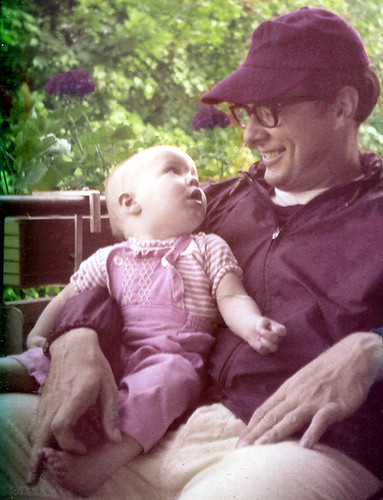
Happy Father's Day

JenDadEnhanced
Dad and Me in Germany, 1970

A wonderful Father's Day link by Mostly Muppet, inspired by the Male Privilege Checklist.

Saturday, June 17, 2006

Bad Gender Planning

Hanno just alerted me to this interesting op-ed piece, "The Weaker Sex," by Marianne Legato in the NYTimes. Legato clarifies that by studying gender-specific medicine, she is not just studying women (interesting how in many peoples' minds gender=woman), but rather looks carefully at sex differences in disease, illness, life expectancy etc. She reports:

What emerges when one studies male biology in a truly evenhanded way is the realization that from the moment of conception on, men are less likely to survive than women. It's not just that men take on greater risks and pursue more hazardous vocations than women. There are poorly understood — and underappreciated — vulnerabilities inherent in men's genetic and hormonal makeup. This Father's Day, we need to rededicate ourselves to deepening our knowledge of male physiology.

Men's troubles begin during the earliest days in the womb. Even though there are more male than female embryos, there are more miscarriages of male fetuses. Industrial countries are also witnessing a decline in male to female birth ratios, and we don't know why.

Some scientists have argued that the probability of a male child declines as parents (especially fathers) age. Still others have cited the prevalence of pesticides, which produce more birth defects in male children.

Even when a boy manages to be born, he's still behind the survival eight ball: he is three to four times more likely than girls to have developmental disorders like autism and dyslexia; girls learn language earlier, develop richer vocabularies and even hear better than boys. Girls demonstrate insight and judgment earlier in adolescence than boys, who are more impulsive and take more risks than their sisters. Teenage boys are more likely to commit suicide than girls and are more likely to die violent deaths before adulthood.

As adults, too, men die earlier than women. Twice as many men as women die of coronary artery disease, which manifests itself a decade earlier in men than women; when it comes to cancer, the news for men is almost as bad. Women also have more vigorous immune systems than men: of the 10 most common infections, men are more likely to have serious encounters with seven of them.

While depression is said to be twice as frequent in women as in men, I'm convinced that the diagnosis is just made more frequently in women, who show a greater willingness to discuss their symptoms and to ask for help when in distress. Once, at a dinner party, I asked a group of men whether they believed men were depressed as often as women, but were simply conditioned to be silent in the face of discomfort, sadness or fear. "Of course!" replied one man. "Why do you think we die sooner?"

Considering the relative fragility of men, it's clearly counterintuitive for us to urge them, from boyhood on, to cope bravely with adversity, to ignore discomfort, to persevere in spite of pain and to accept without question the most dangerous jobs and tasks we have to offer. Perhaps the reason many societies offer boys nutritional, educational and vocational advantages over girls is not because of chauvinism — it's because we're trying to ensure their survival.

It's possible, too, that we've simply been sexist. We've complained bitterly that until recently women's health was restricted to keeping breasts and reproductive organs optimally functional, reflecting the view that what made women valuable was their ability to conceive and bear children. But aren't we doing the same thing with men? Read the questions posed on the cover of men's magazines: how robust is your sexuality? How well-developed are your abs? The only malignancy I hear discussed with men is prostate cancer.

I have bolded the interesting and provocative point. And, I also want to take a moment to point out why I think more men should be interested in gender studies and feminist theory. Here is a woman, using the tools of gender studies, to offer up an interesting analysis of how 'masculinity' as a cultural role is dangerous for men in multiple societal contexts.

The War Tapes


Last night my family headed to the Maui Film Festival to watch The War Tapes (trailer). I left the screening with a deep insecurity about governments, motives, and the human cost. The War Tapes is a documentary shot by three soilders: Seargent Steve Pink, Specialist Mike Moriarity, and Seargent Zack Bazzi. It is raw footage: you see bits and pieces of bodies torn apart by IEDs, how insecure the roads are, you feel the fear of the soilders . . . It is hard to watch this film and ever glorify war. Even the most gung-ho soilder, Mike Moriarity, struggles with understanding why he has given a year of his life to this war, which he fully supported (and says he still supports Bush and the war).

Majikthise has already written a fine review of The War Tapes here. So, I will say a few words about what haunted me the most about The War Tapes. You get to see the men after they return from their year in Iraq, and each of them struggles with PTSD, reintegrating into civilian life, and how this affects their work, familial relationships and romantic ones. Seargent Pink, we are told, does not treat his PTSD and he might still be called up to go back. His girlfriend struggles with how to talk to him and watches him tortured at night. While Bazzi is by far the most critical of the war, Pink's diaries and commentaries are the ones that illustrate to me the ignored cost of war.

Pink describes, at one point, how his fellow soilders began arguing over what kind of meat a severed limb most resembled: pot roast or hamburger. Human intestines are definitely sausages. As he writes these descriptions, he is fully aware that this way of rendering human bodies in order to cope with the violence will continue to haunt him. At the end of the film, he describes how he felt when he finally got to participate in killing some insurgents. He takes photos of all the corpses, photos which we get to see, but only while he tells us how his superior was critical of him for taking them. Pink points out that he wasn't trained to see these men as anything more than objects, to dehumanize them, to hate them. That is how he is able to kill. He also describes how a dog started eating the flesh from one of the bodies, and rather than shoo the dog away, he cheered him on: "fill your belly."

That scene is haunting, particularly because Pink is so articulate, thoughtful and fully aware how screwed up this is making him.

The war never ends for these men. Furthermore, not one of them easily justifies to himself why they are fighting. Moriarity, who signed up to fight in Iraq after 9-11, admits many times that they are protecting KBR/Halliburton, and Sgt. Pink points out that if this war is for money, then someone besides Dick Cheney better be getting some.

Bazzi is an Arab-American, originally from Lebanon, and we first learn that he is an avid Nation reader. Bazzi often talks to young kids in Arabic, and tells us that other soilders asked him to translate their orders to the Iraqi civilians. At one point, a supervisor tells Bazzi to insist that a man with a very sick boy not cross the road to the hospital, and Bazzi explains that he just stopped translating; he saw no tactical sense and he wasn't going to be the messenger.

One last observation. At least twice in the film a woman or a young girl becomes the only kind of Iraqi capable of challenging these mens' dehumanization of all Iraqis. They never know who is the enemy, every car that they pass, every civilian on the road, can be an insurgent. And, so they become aggressive when they find a car pulling in front of them or a man walking on the street in front of their Humvees. But, when they see a woman in the car, or when they hit a young girl holding cookies (whose body lays in pieces), suddenly the Iraqis become human again and the inhumanity of this war floods them.

When The War Tapes is released, I hope that every American, especially those who supported or continue to support this war goes to see it.

Friday, June 16, 2006

How Faculty Lose Power

Warning, this is likely to be a long, meditative post!

I spent the last few days talking to my father about how health care providers are undermined by health care administrators. While I am not as eloquent on this matter as he is, it did get me thinking of the parallels to academic faculty and college/university administrators. Ever since I got tenure, and had a chance to pick my head up from the insane work pace that I threw myself into to get tenure, I have realized how little power the faculty have at my institution. This is not uncommon among most higher learning institutions. I started to think of myself as a "cog in the machine" or a day laborer punching in and out. And, this was all the more frustrating when I realized how much voluntary and involuntary committee work I do.

Being the wide-eyed girl I once was, I saw my participation in committees, especially those I voluntered for, as a way of bettering my college and using my particular expertise and devotion to the place to do so. Boy, what a naive chica I was! I would spend hours in "planning meetings" or "strategic sessions" only to find that all of my energy and time was a waste. At the end of the semester or year long work, nothing would change. It was buisness as usual.

So, I started asking myself "why"? First of all, why do administrators put together these committees, e.g. how to increase diversity, or how to address eating disorders, or how to inspire engaged learning, if the end result is to either not adopt the changes or to do so in a watered down fashion that doesn't really change, fundamentally, how things are done? Secondly, why was I so foolish (perhaps it was more a product of feeling flattered that I was asked?) to give my precious time away to these committees?

The second answer is easy: total naivete on my part. I love to analyze problems (or in administrators rhetoric "opportunities" or "challenges") and come up with novel, innovative approaches to tackling these problems. After all, that is what my intellectual work is all about (i.e. why do so many women take Prozac?) So, I was happy to translate the tools of my trade, and my passion for practical thinking, into concrete action at my college.

The first question is more complicated. Sure, sometimes administrators are sincerely interested in tackling these problems and want feedback. Heck, let's be generous and say they all do. But, what happens once the brainstorming sessions get underway is that the changes needed would require instituional overhaul, and let's face it, institutions are averse to radical change.

I do have a more cynical answer to that first question: administrators like to create the illusion that they care about what faculty think, but at the end of the day they are going to do exactly what they want to do. If they ask faculty to participate, they can make faculty think that their voice and ideas matter. It is a clever form of flattery: "hey, you guys have some expertise here that we could use to improve our institution." Faculty bite--especially young, wide-eyed, untenured ones. But, once the planning sessions get underway, administrators start hurling a raft of objections to faculty ideas: "that is not realistic" "that could open us up for litigation" "alumni might be alienated by these changes." Some of these objections have merit, but all of them reinforce the inherent conservativism of institutions. The unfortunate consequence is that colleges avoid exciting and bold change, precisely the kind of change that would match their actions with their rhetoric.

The more I muse on higher learning institutions, the more I see that faculty are merely day laborers. This is a shame. Without us, there is no "product" (the fact I used that word makes me cringe, since it illustrates how much we have turned education into a commodity). And, yet we have managed to forget that fundamental fact. We give up our power incrementally, because we are overworked or we are scrambling to get tenure. When you are looking to get tenure, you can't be bothered with a bunch of other responsibilities, like oversight of budgets, non-academic division, etc. Leave that to the administrators. And, we do. And, guess what, those offices grow, and that bloated bureacracy chips away at our power and our voice as faculty. We start to work for the adminstrators.

To give a rather mundane, yet poignant, example: The other day I was giving a presentation for our alumni weekend. I wanted to run it from my Mac, since I am a Mac user. In order to do so, I had to come up with my own equipment, since our IT folks do not like Macs or support them. When I asked the woman helping me if our recent college podcast signalled that finally Mac users will get some help, she said "no, IT doesn't like Mac."

That statement illustrates perfectly how we faculty are working for administrators. They are not here to help us do our job well or our research well. It seems to me that the goal of the IT department would be to help facilitate faculty research and teaching. Furthermore, faculty know what machines and operating software is best suited to accomplish that. Why would an IT person get to dictate to a molecular biologist, for example, that she had to use a PC and Windows, if her work required another machine? What sense does that make?

I don't want to belabor this particular example. But, it makes a point.

There are multiple ways that faculty have given up power to administrators. And, frankly it is our fault. We couldn't be bothered with all the meetings, legislation, bylaws, bureaucratic rhetoric. "Just leave me alone to do my work."

Silly Question of the Day

I am perusing my father's CD collection while driving his car to the beach yesterday and stumbled upon a CD that I would never have guessed my Dad would buy: Louis Prima. This is the man that introduced me to Led Zeppelin and had the Woodstock album. Luckily, a CD I expected to find was there as well: The USC Fight Songs (my entire family is insanely devoted to the USC Trojans).

So my question is, what unexpected CDs have you found among your parents collection? Which predictable ones were there, that gave you comfort?

Thursday, June 15, 2006

Prozac Doesn't Get Anorexics Eating Again

Joseph from Corpus Callosum reported on a recently published study that demonstrated that fluoxetine (Prozac) does nothing to treat anorexic patients. Joseph points out that one problem with this study is that all of the patients were also receiving cutting edge Cognitive Behavior therapy, hence making it hard to determine whether or not giving fluoxetine to patients who do not have access to such therapy will be improved by taking Prozac.

What was of particular interest to me in Joseph's post was the following:

Often, for patients with anorexia, an antidepressant might be recommended, not to help maintain weight, but to treat anxiety and/or depression.

Could it be that the study showed no benefit in maintaining body weight, but that patients benefited in other ways? Maybe they experienced improvement in depression or anxiety, or overall quality of life.

It turns out that the authors looked at all of that. The only benefit they found was in a reduction of anxiety, as assessed by the Beck Anxiety Inventory. Depression did not improve, and quality of life (as measured by the Quality of Life Enjoyment and Satisfaction Questionnaire) did not improve.

So, although anxiety scores declined, if that is the only benefit, and overall quality of life did not improve, I would have to agree with the conclusion that the medication simply did not help these people.

What intrigues me about this finding--that the fluoxetine did some good in reducing anxiety levels--is how the researchers tease out anxiety from depression. I am not disagreeing with the distinction between depression and anxiety, in principle, but I just think in practice it is hard to figure out what sort of mood disorder a patient has (yes, I am an armchair Psychiatrist, so you shouldn't listen to me!) In obvious cases, depression looks very different from anxiety. The depressed person is totally immobilized, hopeless, guilt-ridden, while the anxious person is often moving a mile a minute, worrying over every little thing and unable to sit still and relax. The depressed person cannot get going, the anxious person cannot stop going.

Alas, these are just some phenomenological observations. So, given how differently I perceive these disorders, an anxious depressed person (with anorexia to boot!) has got to be hard to diagnose well. Hence, this is why I am intrigued that the fluoxetine can treat just the anxiety without touching the depression.

In fact, this confirms my view that SSRIs, particularly fluoxetine, are not very good at treating depression, that is Major Depression. They are much better at taking the edge off of anxiety in patients that are not really depressed, but have low self-esteem or constitutionally fearful of change.

I would imagine that anorexics are often quite anxious and their eating disorder is a manifestation of a desire to exert some control over their unruly self, if they cannot control the world. (Perhaps I sound too psychoanalytic here?). Anyway, the ability for a drug compound to effectively turn down the internal amplifier (one of Peter Kramer's metaphors) and thereby lessen the anxiety of non-depressed patients (who for whatever reason turn out to be women) is such an interesting technological development. While it does seem to do little to help really sick people (i.e. MDD or anorexics), it does help neurotic chicks chill out a bit.

I got "Mauied"

Sorry that my posts are showing up at erratic times, but I am, believe it or not, in Maui visiting my Dad for the next two weeks. Hence, I am off by 6 hours. I woke up at 3:30 am this morning since I am still jet-lagged, but decided it was best to go back to sleep. Now, I am sitting in a cafe across from the beach. When I finish my coffee, I am jumping into the deep blue.

Before that time, however, I will probably put up a post or two, since there are some good discussions going on in the blogosphere today.

Wednesday, June 14, 2006

The Politics of Breastfeeding

SteveG and Aliyaah alerted me to this Science Times piece addressing the recent scientific findings about breastfeeding. I had just recently spent time with my co-author, Lucy, who explained to me that most experts agree that mothers should breast-feed for 6 months, so the information wasn't new. And, frankly, I am less interested here in disputing the scientific evidence of this claim; I trust that this research is well-grounded and informative for the public.

Obviously what is more interesting is the question of what is the political import of this finding. That is, what is a responsible stance that our government agencies, such as HHS, should take in light of these findings. The Times article reports that:


A two-year national breast-feeding awareness campaign that culminated this spring ran television announcements showing a pregnant woman clutching her belly as she was thrown off a mechanical bull during ladies' night at a bar — and compared the behavior to failing to breast-feed.

"You wouldn't take risks before your baby's born," the advertisement says. "Why start after?"

Senator Tom Harkin, Democrat of Iowa, has proposed requiring warning labels, on cans of infant formula and in advertisements, similar to the those on cigarettes. They would say that the Department of Health and Human services has determined that "breast-feeding is the ideal method of feeding and nurturing infants" or that "breast milk is more beneficial to infants than infant formula."

Are these the right responses to the scientfic findings? Here is exactly the kind of question ripe for moral and political deliberation. Now, there are some who might challenge the science either on the grounds that it is bad science or on the postmodern grounds that it is bad rhetoric. Fine. But, if you decide to accept the data, you still have to figure out policy and how this information impacts the moral claims of feminism as well as the moral obligations of mothering.

What is unfortunate is that the response, at least the one discussed in the Times article, is (a) anti-feminist and (b) incredibly short-sighted. First of all, to suggest that mothers who do not breast-feed for 6 months are as reckless as pregnant woman riding a mechanical bull is just another example of the fear tactics that many right wing folks use to impose duties on citizens. Now, clearly the scientific information suggests that mothers do need to reconsider their duties to their children, but to get them to do so through fear mongering or guilt trips is not likely to be, in the long run, good for the mental health of already stressed out mothers. The fact is that the "mommy wars" angle--namely, to pit stay-at-home moms against working mums--is counterproductive to any good deliberation about how to best provide for our children and help families do so.

Ma Ma Feminista astutely points out the practical and moral problems with this conservative, fear mongering approach:
Perhaps it results from a conservative push back to traditional gender roles. Lets face it. Breastfeeding every two hours for the first four months puts a damper on mobility. Its just plain easier to stay in the house no matter how insane you become. I personally have stopped the car on many of occasion just to get out and about. The outside public envoironment is not conducive to breastfeeding mothers. The public doesn't want to see it but yet the public space does not make even the smallest accomadations. There is one department store in the mall that provides sitting areas for moms, otherwise you have to find a dressing room. How hard would it be to place a chair of some sort in the bathrooms at restaurants? Mothers should not have to navigate these tricky cultural hangups. Geographical locales around the nation are different but here in the South if I was to breastfeed in public people would stare or avoid me like the plague but there is no where to go in most public places, so what the hell are you suppose to do? Given our current political climate on morals, values, and the obsession with same-sex marriage it does not surprise me that such advertising is out there. Just another way to keep the backlash against women and mothers in the public sphere going strong. I've said it before and I'll say it again......This culture is anti-mother which subtextually translates into anti-child and anti-family.

Sequestering breast-feeding mothers, albeit indirectly, is surely not good for the long-term health of the infant. Isn't the mother's isolation, distress and exhaustion likely to impact the child, i.e. cause resentment. To suggest that the only viable way to heed the scientific evidence is to discipline mothers who do not breast-feed, without providing resources and support to make this possible, is hostile to mothers. As responsible citizens, we should seek out institutional supports to make it easier for women to nurse without either guilting them into quitting their jobs, if they can afford it, or making them feel horrific if they cannot afford to take off time from work.

Look, the feminist response here is to ask our policy makers and politicians to consider the mother or the pregnant female when thinking about how to regulate and structure institutions. Obviously, if the default view is the unencumbered male, then work and public spaces are not going to accomodate women who want to be good mothers without becoming shut ins.

One of the issues in the "mommy wars" arguments that gets ignored is the significance of work for the identity of most human beings. To be able to channel your intellect and imagination into public projects, that enable you to leave a legacy, whether those projects be huge or small, is part of what animates us. Certainly raising children can be one of these public projects, but only insofar as it is rewarded and perceived as valuable cultural work. One cannot reward this work simply by lauding the self-sacrificing woman who tends to the emotional and nutrional needs of her spouse and children. If we want to elevate child-rearing to the status of transcendent work, as opposed to the immanent work of turning oneself into an object to be consumed by others, then we need to start publically recognizing it through remuneration, better institutional policies that support families, greater resources devoted to helping mothers (e.g. state-sponsored day-care, health care, child enrichment programs).

But even if we were to radically change institutions in ways that better supported women in their role as mother and publically recognized it, many women would still yearn to use their talents in the public sphere in others ways.

Alas, good deliberation about the political and moral consequence of scientific findings, that does not merely revert back to 1950's gender roles, is sorely lacking. Without it, we politicize science, rather than rely on science for good politics.

Tuesday, June 13, 2006

Lazy Sunday: "I Prefer Map Quest. That's A Good One Too!"


So I am probably the last person to have seen this freakin hilarious new digital short from SNL. I don't have TV and if I did, I probably wouldn't have watched SNL. But this whole digital short thing is totally reviving my interest in the show, despite what Slate says.

Anyway, if you are indeed the last person to see "Lazy Sunday," then you need to go here.

I have already watched this 5 times while sitting in the Phoenix airport. I can't help cracking up!

Empathy Isn't Just for Pussies

The Happy Feminist has a nice post on the importance of empathy. In recounting a case she tried as a prosecutor, Happy tells us:

When I was a prosecutor, I argued for the maximum sentence for a man who had kidnapped his ex-girlfriend at gunpoint in the hope of running off across the country with her and marrying her. He thought he could make her love him through use of force, including beating her, threatening her with a gun, and holding a knife to her throat. I told the judge that this guy was extremely dangerous because he completely lacked "empathy." In other words, he completely lacked the ability to see a situation from the point of view of the other person involved. The defense attorney then went off on how "inappropriate" it was for me to impose "feminist New Age values" like "empathy" on his client.


My jaw dropped when I read those lines. I can’t help but worry about the toxicity of masculinity when I hear such comments. To imagine that empathy is a trait for “pussies” makes me seriously worry about the fate of men. Certainly there are many empathetic men, and many fathers who encourage their boys to be empathetic towards others. Without empathy, human interaction and community are impossible. In fact, without empathy, ethics would be impossible.

Sure, Immanuel Kant argued that we should always do the right thing independently of our inclination to do so; moral acts are moral only insofar as we act out of our duty. Such a rule-bound approach to ethics, however, is how we end up with utterly inhumane legislation like this new bill being offered in Ohio. Those who propose it believe to be acting in accordance with duty, with principles, and yet fail to empathize with those women who would seek out abortions.

SteveG is found of saying that figuring out what to do is usually quite easy; only in the hard cases do rely upon moral deliberation. And, he is right. However, moral deliberation should involve far more than discerning the proper rules; we need to pay attention to peoples’ stories. Without the ability to imagine ourselves in the place of the Other we are likely to fall into the trap of moralizing. Moralizing is bad. Moral deliberation is good.

Women are encouraged quite early on to pay close attention to the emotional life of others; we are depended upon to notice when others are suffering, angry, fearful and then respond with compassion and care. This is emotional labor; paying close attention to others and sensing their needs requires time and energy. This emotional labor has traditionally freed men up, allowed them to focus their energy and time outward, toward creative projects. Women focus their energy and time inward, toward the home, the self, and relationships.

What feminists have pointed out for decades is that encouraging men to see the world as conquest, as raw material for their creative projects, at the expense of their ability to make meaningful connections to others is risky.

Another Pro-Death Bill in Ohio

Seriously, what is up with Ohio? Via feministing, I got wind of Ohio House Bill 228 that would criminalize all abortions, even if the abortion was procured to save the life of the mother. There is simply no excuse for this type of heinous legislation.

How many of the pro-death crowd would willingly sacrifice up their own mother, sister, daughter, wife, or girlfriend in order to protect a zygote or fetus?

Monday, June 12, 2006

P.R. Stunt or Desperation: A False Dichotomy

I am listening to BBC's "World Have Your Say," and I find myself utterly outraged at how the current debate about the suicides at Guantanamo has been framed: "P.R. Stunt" or "Desperate Act." Callers are picking one side of the other. And, the particular framing forces those who want to argue that this is a desperate act to expend energy giving evidence for why this is indeed an act of desperation. Frankly, I don't get this question. It bothers me that those who see this tragedy as a "P.R. Stunt" are therefore unable to still consider this an act of desperation.

If people choose a public way to express their outrage with their detainment and the U.S.'s total disregard of the Geneva Conventions, why does that make it any less of a tragedy or any less an expression of desperation. Taking one's own life is never an easy decision. These men hung themselves, which a particularly painful way to take your life. If all three of them coordinated this effort to gain attention for the abuses at Guantanamo, then this cannot be dismissed cavalierly as a "P.R. Stunt."

I am repulsed by this language, utterly repulsed. This is a tragic event and to lull ourselves by dismissing it as a "mere P.R. stunt" is just plain inhumane.

The Male Privilege Checklist

Via the Red Queen, I was directed to Alas, a blog for their on-going Male Privilege checklist. This checklist builds off of Peggy McIntosh's piece "Unpacking the Invisible Knapsack." McIntosh's piece guarantees excellent discussion in any class about what "privileges" are, i.e. unearned privileges and how those differ from unearned entitlements. McIntosh's goals was to help white women understand why men resist feminism and the fight for gender equality. Her point was not that these men necessarily are misogynists, but rather that the invisible privileges that they benefit from make it difficult for them to understand the basis of many feminist claims.

Ampersand returns to the issue of male privilege and has compiled a list of them on her site. I am including the list here:

The Male Privilege Checklist

1. My odds of being hired for a job, when competing against female applicants, are probably skewed in my favor. The more prestigious the job, the larger the odds are skewed.

2. I can be confident that my co-workers won’t think I got my job because of my sex - even though that might be true. (More).

3. If I am never promoted, it’s not because of my sex.

4. If I fail in my job or career, I can feel sure this won’t be seen as a black mark against my entire sex’s capabilities.

5. I am far less likely to face sexual harassment at work than my female co-workers are. (More).

6. If I do the same task as a woman, and if the measurement is at all subjective, chances are people will think I did a better job.

7. If I’m a teen or adult, and if I can stay out of prison, my odds of being raped are relatively low. (More).

8. I am not taught to fear walking alone after dark in average public spaces.

9. If I choose not to have children, my masculinity will not be called into question.

10. If I have children but do not provide primary care for them, my masculinity will not be called into question.

11. If I have children and provide primary care for them, I’ll be praised for extraordinary parenting if I’m even marginally competent. (More).

12. If I have children and pursue a career, no one will think I’m selfish for not staying at home.

13. If I seek political office, my relationship with my children, or who I hire to take care of them, will probably not be scrutinized by the press.

14. Chances are my elected representatives are mostly people of my own sex. The more prestigious and powerful the elected position, the more likely this is to be true.

15. I can be somewhat sure that if I ask to see “the person in charge,” I will face a person of my own sex. The higher-up in the organization the person is, the surer I can be.

16. As a child, chances are I was encouraged to be more active and outgoing than my sisters. (More).

17. As a child, I could choose from an almost infinite variety of children’s media featuring positive, active, non-stereotyped heroes of my own sex. I never had to look for it; male protagonists were (and are) the default.

18. As a child, chances are I got more teacher attention than girls who raised their hands just as often.

19. If my day, week or year is going badly, I need not ask of each negative episode or situation whether or not it has sexist overtones.

20. I can turn on the television or glance at the front page of the newspaper and see people of my own sex widely represented, every day, without exception.

21. If I’m careless with my financial affairs it won’t be attributed to my sex.

22. If I’m careless with my driving it won’t be attributed to my sex.

23. I can speak in public to a large group without putting my sex on trial.

24. If I have sex with a lot of people, it won’t make me an object of contempt or derision.

25. If I work in an office, I have the option of wearing a relatively value-neutral uniform that does not invite speculation about my sexuality or my gender conformity. (More).

26. My wardrobe and grooming are relatively cheap and consume little time. (More).

27. If I buy a new car, chances are I’ll be offered a better price than a woman buying the same car. (More).

28. If I’m not conventionally attractive, the disadvantages are relatively small and easy to ignore.

29. I can be loud with no fear of being called a shrew. I can be aggressive with no fear of being called a bitch.

30. I can ask for legal protection from violence that happens mostly to men without being seen as a selfish special interest, since that kind of violence is called “crime” and is a general social concern. (Violence that happens mostly to women is usually called “domestic violence” or “acquaintance rape,” and is seen as a special interest issue.)

31. I can be confident that the ordinary language of day-to-day existence will always include my sex. “All men are created equal,” mailman, chairman, freshman, he.

32. My ability to make important decisions and my capability in general will never be questioned depending on what time of the month it is.

33. I will never be expected to change my name upon marriage or questioned if I don’t change my name.

34. The decision to hire me will never be based on assumptions about whether or not I might choose to have a family sometime soon.

35. Every major religion in the world is led primarily by people of my own sex. Even God, in most major religions, is usually pictured as being male.

36. Most major religions argue that I should be the head of my household, while my wife and children should be subservient to me.

37. If I have a wife or live-in girlfriend, chances are we’ll divide up household chores so that she does most of the labor, and in particular the most repetitive and unrewarding tasks. (More).

38. If I have children with a wife or girlfriend, chances are she’ll do most of the childrearing, and in particular the most dirty, repetitive and unrewarding parts of childrearing.

39. If I have children with a wife or girlfriend, and it turns out that one of us needs to make career sacrifices to raise the kids, chances are we’ll both assume the career sacrificed should be hers.

40. Magazines, billboards, television, movies, pornography, and virtually all of media is filled with images of scantily-clad women intended to appeal to me sexually. Such images of men exist, but are much rarer.

41. On average, I am under less pressure to be thin than my female counterparts are. (More). If I am fat, I probably suffer fewer social and economic consequences for being fat than fat women do. (More).

42. If I am heterosexual, it’s incredibly unlikely that I’ll ever be beaten up by a spouse or lover. (More).

43. Complete strangers generally do not walk up to me on the street and tell me to “smile.”

44. On average, I am not interrupted by women as often as women are interrupted by men.

45. I have the privilege of being unaware of my male privilege.

The power of this list is to force men and women to think in concrete terms about how men are still perceived as more important or more powerful than women, and how women internalize a profound sense of inferiority. Also, what this list clarifies is that contemporary feminist battles are more complex than they were in the Second Wave, when sexism was more obvious.

I want to add one last observation here. During the last few months that I have had this website, I have encountered many trolls who show up and predictably complain about the damage that feminists do and how destructive their political activism is to the family or other stalwart institutions. If we let these looney right wingers continue their push back on feminism, then these sorts of concerns above will be pipe dreams to tackle, since we will return to the pre-Civil Rights/Feminist Revolution, wherein women were denied access to professions, education, and any right to make decisions about their body, who they want to sleep with, and when they could terminate an abusive relationship.

Sunday, June 11, 2006

If You Can't Ask For It, You Shouldn't Be Doing It

Here I sit in the Greensboro airport, heading back home. I am reflecting on a conversation that Lucy and I had yesterday, after we discussed Hugo's post on male heterosexuality and pro-feminism. Hugo makes an excellent point when he says "the main goal is to get men to understand that their desires are not women's problems to soothe!" Certainly it is the case that myths of male sexuality--that they are utterly incapable of turning off their engines once you get them going--abound; these myths tend to support the utterly pervasive and problematic move to blame the rape victim, especially in cases of date rape.

Lucy and I started thinking about how we would talk to our own kids (mine being wholly hypothetical) about when to have sex and when not to have sex. I enjoyed this exercise, since I do think quite a lot about what normative claims I would make on young people who are considering being sexually active. Many lefties leave these decisions up to others, but I find that all changes once they have their own kids and start worrying about the highly sexualized culture that young kids are coming to age in. As an example, recently a therapist friend of mine let me know that junior high girls wear multi-colored bracelets-sort of like the black rubber Madonna bracelets that we wore in the day--and each color represents a sexual act. Apparently the game is for a boy to get the color of the act he wants performed by the young girl off her wrist, which then compels her to perform. I was aghast to hear this.

Of course I am a huge and unwavering fan of comprehensive sexual education--and the earlier the better, especially given this sexualized culture. But, one tends to think about sexuality differently when they imagine their own child in the midst of these sorts of games.

Hence, I think that I was able to articulate what I would take to be the necessary attributes that a young person must have before I would consider them ready for sex. And, as I articulate this here, I imagine that many of you will recognize that you don't have these traits, which I will talk about next.

Young people should not engage in sexual activity, and particularly sexual intercourse if they are unable to clearly and in a self-possessed manner be able to talk about, initiate, and negotiate sexual activity while sober. For example, when I teach ethics, and we discuss date rape, many of the men (and some women) often roll their eyes when I talk about the importance of getting consent with their partner. The men immediately object to any suggestion that they need to continually ask for permission, because in their eyes, it sets up situations where they can be falsely accused of rape. When that objection gets voiced, my strategy has been to ask them if it is unreasonable for them to regularly check in with their partner and see if she (these conversations are usually restricted to heterosexuality) is enjoying what you are doing, if she would prefer something different, etc. When I introduce this idea, then all the men and women snicker, because they see this as "weak" or "gay."

At this point, I usually say, quite sarcastically, that if they are not interested or willing to communicate with their sexual partner about how the sex is going, then they would be far better off fucking a blow-up doll. I also point out to the men that they are unlikely to be very good at sex if they don't care to ask their partner how it is working out. This gets their attention, and I think enables us to get beyond the red faces, embarrassment, and rolled eyes to talk about what a healthy sexual interaction should be like.

I don't think that many of us are usually quite good at having these kind of interactions, and if we aren't then we are likely to find ourselves having either bad sex or worse, violative sex. If you cannot establish that kind of communication with a partner, but rely upon alcohol to get loose, then you are in trouble.

Saturday, June 10, 2006

Sue the Hussy

In the midst of all this talk about women, sexuality, and sex roles, I read the front page story of the Greensboro News Record which reported that a recently divorced woman was able to sue the "hussy" who broke up her marriage. She got $500,000.00 dollars, figuring that this is what she would have enjoyed had her marriage stayed together.
This type of law suit is just plain disturbing to my secular, feminist mind. If you are going to sue anyone, it seems it should be your husband. But, the message underlying this judgement is: women's sexuality is so potent that it can break up marriages. So, we need to crack down on the hussies, rather than hold the men accountable.

This reminds me that I have always been baffled by women who blame the "other woman" for their boyfriend's/husband's cheating. While I can understand being pretty pissed off that another woman would think so little of your bond as to willingly participate in such a clandestine affair, the real asshole to my mind is the man. And, let's face it, sometimes the relationship is just plain over and the cheating is a clear indication of that.

Friday, June 09, 2006

What is So Shameful about Sexuality Studies?

Yesterday's post on objectification has turned out to be quite satisfying. Thank you for your comments, which have surely helped me think more about this question. As my co-author and I drove to the library today, we talked about one aspect of the question of "sex-positive" feminism, namely the squeamishness that we see among our mostly liberal colleagues when we try to introduce to them a course of study in sexuality or an administrator position that deals specifically with helping young people develop healthy attitudes toward sex.

As Lucy (my co-author) pointed out, when lefties talk about sex with students, even the administrators, they tend to design that conversation around sharing statistical or biological information, but shy away from the more complicated questions about how to make sense of their quite powerful urges to delight in sexual activity with others. Most of these conversations seem rather clinical. Why? In part I think this is because the adults given the responsibility to faciliate these discussions are pretty uncomfortable talking about sex. We are a culture that stumbles, turns bright red, talks in silly euphemisms, or just plain avoids the topic. We don't prepare ourselves, let alone our children, for inhabiting our sexual self well.

Our students use alcohol as the great lubricator (heck adults do too!). It enables them to make a move, or to delight in the pleasures of the flesh and then disavow the whole thing the next day. The fact that alcohol is the medium for making sex easier or sex talk less embarrassing is a problem. I don't often see my colleagues helping us out here. In fact, they tend to get quite agitated when some of us want to introduce sex, quite explicitly, into our curriculum. Awhile back I wrote a post about the battles in my Women's Studies department over changing the name to Women, Gender and Sexuality Studies. The opponents to the name change were fundamentally disturbed by putting "sex" in the program title.

The more I think about this reaction, the more I am convinced that their discomfort with the word "sexuality" comes from their fear that our curriculum will appear less "scholarly." Sex is too "personal" and therefore does not belong in the Ivory Tower. Somehow, if you want to study sexuality--something which both Lucy and I have done for over 15 years--you aren't doing real work. I think the sense is that you are starting to turn into some sort of self-help guru rather than a serious scholar. And, many Women's Studies folks still fear that they aren't taken seriously as a subject anyway, since, well what they are doing is either too "squishy" or too political, and therefore not "objective."

Unfortunately, living in such fear that others are rejecting your scholarship is not a good way to design your program. I can't think of a more pressing and more important topic for feminists to discuss than sexuality. By ignoring it, we are stunting an essential part of our identity. I have never been disappointed by introducing the topic of sex to my class; my students are dying to talk about it. They want a space where we can get over the silly laughter and the snortles and work through the anxiety, confusion and allure of this kind of human interaction.

In my last post, Metapsychologist pointed out that we need more open discussion on this topic. But where should these types of conversation take place? Conservatives want the family to do it. Liberals want to package this information in safe scientific speak. The churches have their own investment in reserving sex for marriage and pro-creation. Someone has got to help us get over our shame and embarrassment and get talking.

What is so shameful about sexuality studies?

Thursday, June 08, 2006

What's Wrong with Being a Sexual Object?

Well folks I am in North Carolina right now doing some research with my co-author. We have been having wonderful conversations, particulary on the issue of building, supporting, and encouraging healthy sexuality in women. She is working on a manuscript that points out that being a sexual being is often a vibrant and healthy part of being a woman. One of the challenges for modern feminists is find a way to articulate why being a sexual object--that is an embodied sexual being who is inspired by the desire of another--is not necessarily an exploitative relation.

I will be thinking alot about this for the next couple of days. But in the meantime, what has come out of our conversations this morning is the profound awareness that we both have of the failures in our culture (American) to encourage women to possess their sexuality and see it as delightful and pleasurable part of experience. This of course does not mean to say we are concerned with teaching young girls to be more sexually promiscuous--which is already a problematic concept. But rather, the issue is helping young women feel empowered by their sexuality and help them recognize that their sexuality is not someone elses' right. Women can in fact say "yes" to sex, as well as say "no." Unfortunately, saying "yes" is a fraught experience since it is intertwined with cultural messages that the desiring woman is a slut or sex crazed.

There are little cultural representations of women who are desirous and who take delight in their sexuality that don't ultimately tie this behavior to the need for male approval. So while I am thinking more about this topic. I am interested in hearing what you think. Are there representations of female sexuality--wherein the woman takes delight in her body and the pleasures therein--that empower women to enjoy sex without all the anxiety that comes from fearing their sexuality will be used to degrade them or is the only aspect of their identity valued? I am restricting my thinking here to heterosexuality since it seems to me that queer theory has done a much better job of thinking about the "yes" than feminist theory has.

Wednesday, June 07, 2006

PA House Passes Marriage Protection Bill

Alas, the PA House passed HR 2381 136-61. Frightening. Why do they call this a blue state?

Stephen Stetler from York issued this press release, criticizing ('surprise'?) the Republican leadership:


Stetler votes against constitutional amendment and
says House Republicans once again fail to lead

HARRISBURG, June 6 – State Rep. Stephen H. Stetler, D-York, today voted against H.B. 2381 because it could take away existing legal protections, under local laws, for committed long-term heterosexual and homosexual couples and their children, such as hospital visitation rights, inheritance rights, pension benefits and health insurance coverage.

“It really is shameful that the state House is wasting its time on gay marriage legislation when there are more pressing issues like property tax reform, health care and education that need resolved,” Stetler said. “Once again, the House Republicans are showcasing their leadership failure by allowing a vote on gay marriage, but blocking a vote on property tax relief for seniors.”

On May 3, House Republicans prevented a vote on Special Session H.B. 39, which would have raised the income limit for the state’s Property Tax/Rent Rebate program from $15,000 to $35,000 annually, increasing the number of eligible households from 335,000 to 800,000. The state Senate had already passed the bill 40-9 and Gov. Rendell was ready to sign it into law.

Stetler said H.B. 2381, not Special Session H.B. 39, should have been left off the House voting schedule. He voted on a motion today, which failed 88-109, to recommit the bill to the House Judiciary Committee for further clarification of the definition of “legal union” and a deeper study of the bill’s constitutional ramifications.

“I do understand and respect the position of H.B. 2381 supporters from a social and religious perspective. However, as a legislator, I also must examine this issue from a constitutional and legal point of view,” Stetler said. “Hence, I feel that our state constitution is intended to protect families, children and communities. It is not intended to discriminate against anyone for any reason. As a result, a person’s sexual orientation, identity or expression should not determine what constitutional rights they are entitled to.”

Having passed the House 136-61, H.B. 2381 now goes to the state Senate for consideration.

Tuesday, June 06, 2006

Physical Courage=Moral Courage?

There are a lot of things to say about the recent New Yorker issue piece on Oriana Fallaci. She is certainly quite a character and quite a bit frightening. But upon finishing this piece I found myself meditating on her pronouncement that

I have reached the conclusion that those who have physical courage also have moral courage,” she said. “Physical courage is a great test.”

I find this a to be an attractive notion, but I am a bit horrified by my attraction to this notion. Perhaps I find it romantic to think that if one is willing to risk their life for a belief, then one is more capable of doing the right thing in a rather dire situation. SteveG recently wrote on Haditha and how silly the official response was to this horror, namely to offer ethics courses. SteveG points out that figuring out what the right thing to do is not hard; having moral courage is.

So what does it take to have moral courage? Does it indeed demand a kind of physical courage? And if so, what kind--the willingness to die for a cause (Socrates) or a core toughness (Nietzsche)?

Monday, June 05, 2006

Call Your Senators Today: Rebuke Frist

Call your Senators today and oppose this waste-of-time Marriage Protection Amendment. You can find numbers for your Senators here. If you are from PA, flood Specter with calls in his regional offices since this is coming out of his committee.

Bill Frist published an op-ed in the Boston Herald today defending this bigoted amendment, proposed at a time where Iraq is a disaster, Iran is seeking out nuclear weapons . . . seems to me there are far more important issues to worry about than "protecting marriage."

Let's go through this op-ed line by line, shall we?

In the next few days, the Senate will vote on a constitutional amendment to protect marriage throughout the United States. I support this Marriage Protection Amendment for a simple reason: Marriage between one man and one woman does a better job protecting children - better than any other institution humankind has devised. As such, marriage as an institution should be protected, not redefined.

Of course, for his logic to make any sense, you have to assume that the sole purpose for getting married is to "protect children." But, even if you do think this is the sole reason to get married, the empirical evidence does not support this allegation.

Americans know this and, throughout the country, they have supported proposals to uphold the traditional definition of marriage. During the 2004 elections, 11 states approved constitutional amendments to protect the traditional definition of marriage. In all, 19 states have passed marriage protection amendments to their constitutions. In 2004, most proposals received over 70 percent of the vote; none got less than 57 percent.


I would caution Senator Frist from assuming that what some voters want is an indication that something is true. There are plenty of examples of legislation that promoted things that were either morally wrong--Slavery, Segregation, Denial of Female Suffrage--or that are based in shoddy research--the recent Dover decision.

Here in Massachusetts, however, the people have never had a say. The state’s unelected Supreme Judicial Court simply demanded it. In my judgment, the SJC’s ruling represented the worst sort of judicial activism. A majority of the court clearly substituted their personal policy preferences for the law as written. It’s not credible to contend that the original meaning of the U.S. Constitution or the Massachusetts Constitution included a radical redefinition of marriage.


Frist of course is totally in synch and respects what the people want--e.g. Terry Schiavo. But, seriously, where does it say in the constitution that marriage is between a man and woman? Oh right, nowhere! Which is why it is not inconceivable for the MA Supreme Court to find any laws restricting the right or marriage, especially in light of the 14th Amendment, a reasonable judgment. The only activists I see working their tails off to deprive the people of a real debate in this country are the Right Wing.

The Marriage Protection Amendment, which the Senate will debate beginning today, will not only send a clear rebuke to activist judges but it will also preserve states’ prerogatives, help families, and preserve religious freedom. As worded, the amendment simply preserves the United States’ traditional definition of marriage. Nothing in the Marriage Protection Amendment intrudes on individual privacy, stops states from passing civil union laws or curtails benefits that legislatures establish for same-sex couples.


Honestly, this kind of bullshit makes me wonder how this man got a M.D. from Harvard. This is a classic example of PROPAGANDA. The Marriage Protection Amendment (MPA) is unambiguously a violation of religious freedom, is a piece of ACTIVIST legislation, and is not at all the only means by which to protect families, particularly since it will destroy many families once it is enacted. Suddenly you will have child services ripping children from their families if the parents are not married. Immediately, all the parenting rights of the partner in a civil union will be gone. How is this good for children? Sounds rather horrific, traumatic, and fascist.


We need the Marriage Protection Amendment to protect American families. Nearly every social indicator, from household income to individual health, moves in the right direction when marriages are strong and rates are high. Children who live in homes headed by married couples do better by every measure than children living in any other setting. In the Netherlands and many of the Nordic countries where the government redefined marriage - almost always without popular support - redefinition has correlated with a falling marriage rate, and worse conditions for children.


What I want to know is why are there so many single parent households? I would like Frist to convince me that the reason that we see so many broken homes is because we have, as a Nation, failed to protect marriage as between a man and woman. Perhaps you find so many single mothers because they fled abusive relationships with men or were abandoned by men . . .? Let's not forget that Murder is the leading cause of death among pregnant women. What is wrong, btw, with a falling marriage rate? If people choose not to get married, doesn't that mean they are following their own best interest? Are you suggesting that we need to legislate that more people marry, even if they are worse off by marriage or choose not to get married? Talk about social engineering (Happy Feminist had a good piece on this)! If people can enjoy the legal rights of marriage without getting married, and therefore choose not to get married, how is that an argument in favor of the MPA? Afterall, aren't you trying to base this argument on popular support? And, show me the statistics on how children are worse in the Nordic countries, Frist. I doubt you can.

The Marriage Protection Amendment also provides an important protection for religious liberty. Although it appears unlikely that the government would make any religion perform marriages contrary to its teachings, religious charities could suffer serious harm. Massachusetts Catholic Charities, indeed, has stopped placing children for adoption rather than follow a state mandate not to discriminate against same-sex couples. Other charities could face similar dangers if activist judges proceed with efforts to redefine marriage so radically.


Someone clearly hit this guy with the idiot stick. Since when did religious liberty amount to legislative activism intended to narrowly define what marriage should be and thereby prescribe a fundamentalist notion of marriage to all denominations, faiths, agonistics and atheists? Frist needs to take a look at the 1st Amendment again. Furthermore, it seems to me that if the Massachusettes Catholic Charities refuses to let same sex or non-married couples from adopting children, then we should be seriously concerned with how much these organizations value the life of these children. The obvious course to take if such short-sightedness is at work is certainly not the MPA.


Marriage ranks as one of our most important social institutions. Americans have made it clear that they want to protect it against activist judges like those who sit on the Supreme Judicial Court of Massachusetts.


No, Bill Frist and the looney Right Wing fringe, who want to impose their values and institutions on the entire nation are the problem. I don't know about you, but I am sick of this propaganda passing for helpful information, useful for making good and responsible decisions in a democracy.

Saturday, June 03, 2006

Should Feminists Get Married?

Again, I have no answer to this question. Many of my good friends, who are indeed feminists, have been or are married. And, for some of them it is a very meaningful choice because they are Christian. Some of my feminist friends have gotten married solely to take advantage of health insurance benefits and other legal stuff. I have, however, never gotten married. And, the more I think about it, I don't think I have ever truly seen the value of being married.

I was engaged once, but that lasted for such a short period of time and, frankly, I did my part to sabotage it anyway. Lately, I have lost interest in marriage. In part, I don't like the way that it gives 1,400 + rights to married folk that other people in long term, committed relationships do not have. I guess I don't understand why the federal government should favor marriage as the best institution for raising children or declaring your commitment to one you love.

But, I asked if feminists should get married. This is the question that perennially haunts me. Historically, marriage was a means of continuing property relations and reproducing. Women were legally dead the moment they entered into the marriage contract. Obviously, that era is over and people have the right to enter into marriage as autonomous individuals--both man and woman--without losing their legal rights. Marriage is also no longer an institution solely for transferring property and maintaing the patrilineal line.

However, the religious ceremonies are still imbuded--the mainstream ceremonines, that is--with lots of rituals that are reminiscient of patriarchal rule. For example, when the father gives his daughter away to the bride. I tend to get pretty nauseous at those rituals.

Sure, we can redo the ceremony in a way that purges those patriarchal overtones. And, we can take the religious part out of it all together. But, then we are left with the obvious point which is in this era only heterosexuals have the right to get married. So, to participate in this institution is to tacitly approve of the exclusionary nature of this institution. You are willing to avail yourself of the legal benefits at the exclusion of many others who cannot enjoy those rights.

This seems like a real moral dilemma for feminists and other committed to fighting sexism, sex-based discrimination and all forms of heterosexism. What do you think?

Friday, June 02, 2006

Vote NO on the Marriage Amendment

I reserve my post today for some political pleading. On Monday, June 5th both the PA legislature and the Senate will be considering "Marriage Protection" Amendments. I urge all of you to call your Senators and protest this ridiculous move to codify discrimination into the Constitution, thereby cheapening this important document. If you want to find out the number of your Senator, you can go here. If you need background on the Amendment and Talking Points, NOW has two good sites here and here.

If you are a Pennsylvania resident, I suggest you call one of Spector's regional offices.

PA is also considering a "Marriage Protection" Amendment next week. Here is the language of the bill(this is the house version).

"Only a marriage between one man and one woman shall be valid or recognized as a marriage in this Commonwealth, and neither the Commonwealth nor any of its political subdivisions shall create or recognize a legal status identical to or substantially equivalent to that of marriage for unmarried individuals."

The definition of marriage imposes one constituents' view of marriage and a particularly religious view--both of which are anti-democratic and blatant violations of the separation of church and state. But, what is equally worrisome is that if this bill passes, then anyone in a relationship that is like marriage, that is Power of Attorney over your partner, Wills, Joint Adoptions, will no longer be recognized legally. This affects untold numbers of people, including senior citizens, like my grandmother who might choose to live with a man, but not get married so as to not lose Social Security or Federal Pension benefits.

I myself am philosophically opposed to marriage, and therefore my commitment to my partner and all legal agreements would be null and void if this bill passes. This is just plain lunacy.

Furthermore, Ohio passed a similar marriage protection amendment, which lead the state's Supreme Court to find Order of Protections against abusive partners to be unconsitutional if the couple wasn't married. So, the unintended consequences of this bill are futher reaching than just bigotry. They prevent protecting women from abusive partners. They deny any legal protections and benefits to couples, like myself, who choose not to marry. They put in jeopardy health benefits to all couples--elderly to young.

These ridiculous, ill thought out laws are just a ploy of the right wing to get their conservative base back for the 2006 and 2008 elections. The waste of time and the horrific consequences of these amendments should spur all of you to call your legislator and demand that he or she vote NO on HB 2381 and SB 1084!

Find your State Senator here and your House Representative here.

Get to your phones now, because the Pennsylvania Family Institute has already contacted all of its members to call and vote YES. Don't let their voices be the loudest ones.

Thursday, June 01, 2006

Sometimes You Need to Get Away

Girlie Men and Planet Destruction

SteveG alerted me to this nice piece of work over at Cosmic Variance "Feminism: Destroying the Planet." Sean (with tongue-in-cheek) points out that the girlie-man Gore is becoming a silly, wimpy alarmist about the planet, while Harvey 'the Stud' Mansfield is reminding us to return to the halcion days of manliness. If we heeded the Harvster then we wouldn't be in this mess:

You can see it right there, science doesn’t lie. The correlation is clear as the Los Angeles haze — countries that educate women are dumping carbon dioxide into the atmosphere. Now, unless you’re crazy enough to think that it’s the CO2 that is causing all those girls to go get themselves an education, I think the implication is obvious: feminism is destroying the planet.


Mansfield is such a tool.

The Senator You Love to Hate

From Alternet Peek this morning, I was put on the trail by Lindsay at Majikthise to this piece of fantastic news from Will Bunch (Philadelphia Daily Star).

Nothing would bring me greater joy than to kiss Santorum good-bye . . .